
 ·
9 minute read
·
9 minute read
Summary
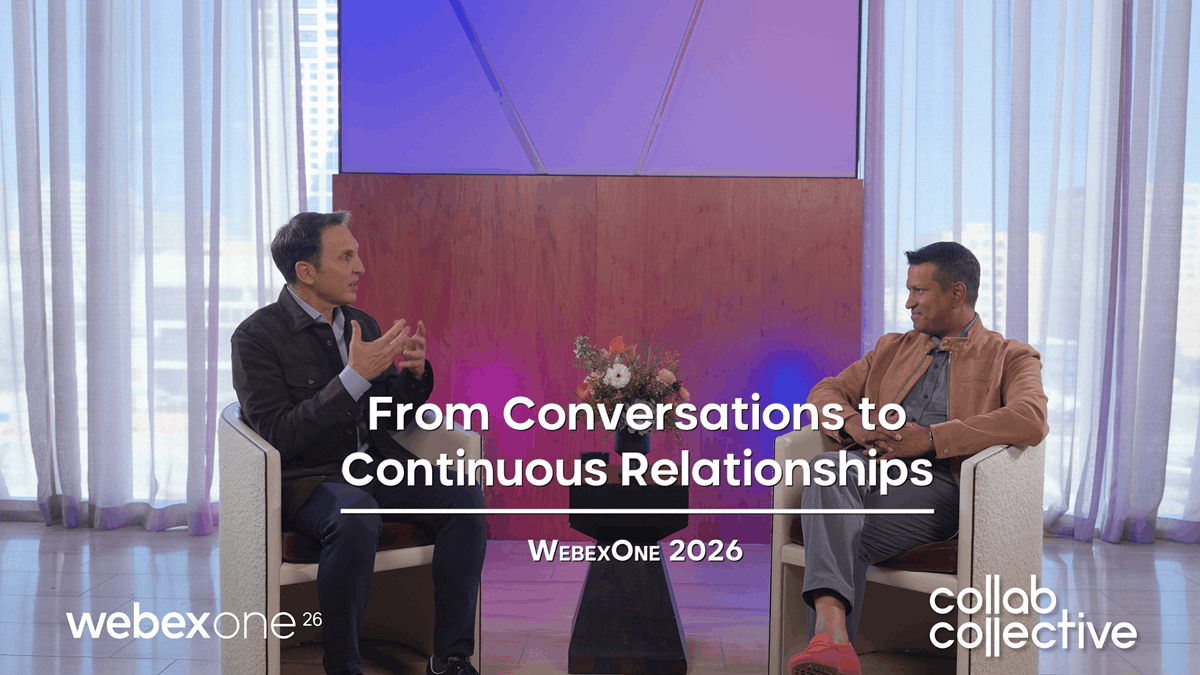
On this episode of Direct from the Expo, the Collab Collective’s Craig Durr speaks with Vinod Muthukrishnan, VP and General Manager of Webex Customer Experience at Cisco, at WebexOne 2026 in Austin, Texas. They explore how AI is transforming customer experience, moving contact centers beyond individual interactions toward continuous relationships. Vinod explains how Cisco’s Dialog platform connects customer and enterprise context to coordinate AI agents, human workers, and business processes.
Their discussion covers:
- From Contact Centers to Context Centers: How Cisco shifts customer experience from answering inquiries toward continuous relationships through contextual understanding
- Dialog and Relationship Context: How Cisco’s Dialog combines enterprise rules and customer history to coordinate AI agents and deliver personalized experiences
- Reducing the Coordination Tax: How AI bridges departmental silos, navigates policies and exceptions, and advocates for customers while involving human agents
- Human and AI Collaboration: How contact centers empower human workers alongside digital coworkers, balancing automation with human judgment for better outcomes
- AI Governance and Observability: How workforce and quality management, AI Defense, and AI Agent 360 secure, monitor, and manage AI-driven processes
- An Open AI Ecosystem: How Dialog supports first-party and third-party AI agents, allowing organizations to integrate preferred tools without provider restrictions
- From Conversations to Relationships: Why customer experience leaders should prioritize relationships and outcomes over metrics such as containment and deflection
Listen to the Audio:
Or tune in on your preferred streaming platform:


Transcript
Craig Durr: Everyone, this is Craig Durr, Chief Analyst and Founder of the Collab Collective, and I want to welcome you to another episode of Direct from the Expo. This is a special event. This is from WebexOne 2026 in my hometown of Austin, Texas, and I have a chance to bring to you insights from the executives that are bringing this story to life. Joining me right now is Vinod Muthukrishnan. He is the VP and General Manager of Webex Customer Experience for Cisco.
Vinod, how are you doing?
Vinod Muthukrishnan: Fabulous, and thanks for having me on board.
Craig Durr: I appreciate this. This is an exciting event. You have a lot of great customers out there, a lot of great partners, a lot of great energy going on right now.
Vinod Muthukrishnan: Yeah, I can feel the energy on the floor. I love seeing our customers, our partners, our teams come together in person. There's no substitute for that.
Craig Durr: So let's go ahead and dive into some of the conversation here. Talking about customer experience. AI has been on the forefront for the last few years, but it's evolving. What do you think about AI and that contact center experience now?
Vinod Muthukrishnan: You know, I draw from my personal experience because AI is the first enterprise technology that's been mass commercialized. Everyone's used it, everyone has an opinion on it, and so that's why we've seen three years ago people were writing cute poems with it. It was a nice little toy, and then it became a tool, and became a chatbot. It could answer questions. It could do one thing or the other. I think we are currently in the present continuous phase, where it actually becomes a digital coworker, and that means a dramatic expansion of capabilities, dramatic expansion of the risks associated with AI. But honestly, the most dramatic expansion of opportunity with AI.
Craig Durr: It's fantastic. That means as a digital coworker, this is really going to change the whole layout of how that contact center works. Let's go ahead and dive into that, and let's start with the customer. Now, you had a really powerful phrase on stage. You talked about going from a contact center to a context center, a center of context. Explain to me, what does that mean?
Vinod Muthukrishnan: So let's start with the problem statement. We often joked about it. I said it on stage. You know, if you stay on the phone long enough with a company, you'll discover its entire org chart because you know, you got to navigate teams, process, policy, exceptions, humans, and now AI, and just to get what you want to get done, and we call it the coordination tax. Now, this coordination tax often is paid by the customer because it's very expensive to bridge it. If you're the lucky 0.1% of super uber elite platinum customers, you get a personal relationship manager. They pay the coordination tax, and you basically have a seamless single window experience.
Craig Durr: Right
Vinod Muthukrishnan: But obviously, you can't do that at scale for all your customers. It's not that brands don't want to do it. It is just not feasible to do it. The big change for us is to take that coordination tax away. Dialog, the platform that we announced and very excited about, allows you to actually offer personal relationship management at scale to every single customer, where AI takes the coordination tax for pennies to the dollar. It synthesizes all the context.
One is enterprise context, which is what the enterprise rules, philosophy, guidance. How do you navigate the org? There's customer context, which is who you are, and when these two worlds meet, you get something very unique called the relationship context, which is how would I treat you, Craig, if you walked in the door, no matter which door you walked in from. That is relationship context, and when you get that, you go from being a contact center answering questions to a contact center managing relationships.
Craig Durr: And Dialog, this is the superpower that enables you to do that, right? But walk me through this. What does this look like from a customer experience? You know, you had a great example.
Vinod Muthukrishnan: Yeah. So look, the simple fact is, AI agents or human agents do not fail because they wanna. It's because either they have only access to that much data, don't have discretion, or they need to check with somebody else, and they can't essentially exactly put you on the line and walk to the adjacent department to talk to the teams, right? So it's the coordination tax that makes the front line ineffective.
And those enterprise silos, rules, departments, policies are not going to go away. The purpose of AI is to help you very efficiently navigate that complexity, and that is what Dialog does. And the example we had was, you know, a missed flight.
It starts with Dialog reaching out, saying, "Hey, you missed your flight,” and then you say you had a medical emergency, long, long stuff. But then Dialog knows to redact that. It knows two things. One is on the face of it, I can't give you the refund. Next, it picks up context, the word that you really liked, which says your platinum 1.2 million miles, and it knows from some other document there is an exception policy for platinum customers, but the guardrails tell the agent powered by Dialog that you can't approve it. So enter the human, and so it takes all this context. It even takes context around things like your flight was delayed a couple of weeks ago, not pertinent to the conversation, or even this journey, but it's pertinent to the relationship, and it takes a case. I love the part where the agent powered by the harness Dialog actually pleads the customer's case with the internal supervisor, saying, "You've got to do this.” Funny enough, the internal supervisor may or may not know that they're dealing with an AI agent.
It's an entity that's a messaging-based exchange. It actually goes and says, "Look, you can't do this, we’re not super platinum, flown X miles with us. And you know what? A couple of weeks ago, you delayed his flight and gave him a lounge pass. I forget what the exact thing was, but you gave him a lounge pass, and that's not enough. Like, you can't be doing this to him.” So it does that, and that's what I love, the predictive preemptive part.
But the thing I also loved in the end was, it also knows you have a holiday voucher you've not used. So it's literally like, if you only dealt with me for the last 10 years, I'd have all of this in my head, and I'd be like, "Hey, Craig, before you go, I have a vacation package you've not used. It's running out of time. What are you going to do?” And then we transition to my personal AI agent, and we close the demo as you saw with the guy saying, "Hey, I'm busy. I'm on stage in front of my few 1,000 best friends. So why don't you work with my AI agent? Have my agent talk to your agent, and get the job done.” And that is the dramatic transformation we're looking at.
Craig Durr: That is incredible. We're talking about a layer creating this concierge-like service. This is a true relationship. This is this agent knowing the node, this agent knowing each of your customers, and acting on behalf of the brand and an advocate for that customer as well. Now, one of the interesting challenges, though, is how does this work with other third-party AI agents? I mean, I talk to a lot of IT executives. They've already gone down the path of making investments with other AI tools. What is Dialog's story?
Vinod Muthukrishnan: For us at Cisco, openness is a cultural and a technological attribute—architectural, if you may, which means even if there's a first-party product of choice, we'll still keep the system open to third parties.
Craig Durr: Okay
Vinod Muthukrishnan: And decidedly, you have your choice of agents. You have a choice of tools. We need to integrate and more importantly interoperate with them. So Dialog, the control layer, it actually allows first and third party agents, and so we're not constraining you. And so, pick what works for you, and let Dialog do the magic for you.
Craig Durr: That's fantastic. So as you transform that customer experience, there's other elements in the contact center that are also transforming. One of them has to be the workforce in itself, right? You're describing a scenario where you have digital workers working alongside human workers. What is the secret to managing that?
Vinod Muthukrishnan: I'm glad you asked. It's multiple levels. This could be the next 60 minutes of our lives, but I try to keep it concise. So when you talk about AI going from a toy to a tool to a digital coworker, it's not just a marketing slogan. We've got to have the scaffolding that supports that reality.
So we told you the capabilities, now let's talk about governance and manageability. With our workforce management, we announced quality management for both human agents and AI agents. The second important thing is, if you notice earlier, most folks know that people don't go and have like 30-minute conversations with AI agents. 30 seconds, 60 seconds, 90 seconds. So we were talking about securing, observing, controlling, governing, managing a 90-second conversation. Yeah, it's a two-minute conversation. We just showed on stage the conversation being the tip of the iceberg, and now we're talking about the process running inside the org, coordination between humans, another AI agent and the other systems, processes that may run for hours, days, and even weeks or months depending on the nature of the process. So the surface area that you need to govern, secure, observe, control, and manage just went up 100x or 1,000x. That means the role of security and observability embedded in this becomes that much more important, and that is why we spoke about AI Agent 360, the big announcement.
A few months ago, we announced AI Defense in it, right? And now, we announced AI Agent Observability as part of AI Agent 360, which means you can secure, observe, manage all of these actions in the conversation, inside of your organization, and every single turn of that is observed and managed. And I think that if you don't do that, it's almost not feasible for you to run these long horizon agent platforms.
Craig Durr: And to talk about this, you're able to do this in the same control plane as your humans, as your agents as well, right? You're not creating double the work for those. Contact center leaders, you're actually helping this into a synthesized experience, it sounds like.
Vinod Muthukrishnan: Absolutely. Again, as you evolve from optimizing for conversation. See, during the first wave, we said, "Oh, I need to contain 8% of my conversations.” Now, we both have spoken about this before. Containment, deflection are bad terms because as a customer, you neither want to be contained nor deflected. Yet, there's a commercial imperative, right? But from conversations, when you went on journeys, you said, "Okay, let's have a concierge agent that can navigate the journey.
Now, we're talking about relationship management. As you put that hat on, you will pick what conversation you want to automate. You talk about what journeys you want to optimize, but more importantly, irrespective of the nature of the conversation or the nature of the journey, you're always putting your relationship hat on. And that means I'm optimizing for a journey where it may be AI-only, it may be AI-led, it may be human-only. Actually, now human-only is always AI-assisted.
So pick your poison. Give the most optimal path for the customer, deliver the outcomes they seek, do it for pennies to the dollar, and guess what? Everyone is happy.
Craig Durr: So what you're talking about here is not only a recreation of that customer journey and experience, but also of those contact center workers, as well as the leaders in the environment. Their observability, their opportunity to still manage and to create these optimal scenarios seems they're empowered.
Vinod Muthukrishnan: No, absolutely, and that's why I loved what you asked, which is it should not be. You know, we always talk about just containment, which is bringing AI here, don't listen to humans. Great experiences are powered by humans, and we should empower those humans to deliver those experiences with the aid of AI, and use AI to automate the things that we should not be doing. And if you bring those two beautifully together, I feel you'll just have better empowered, happier, better service delivering customer agents, human or AI.
Craig Durr: Well, let's help out our humans in the audience. So, what can they do if they want to learn more? What about the humans here at WebexOne?
Vinod Muthukrishnan: If you're at WebexOne, and you haven't come to the booth and see live demos of Dialog, AI Agent, AI Assistant, and all the cool things that we've built. Please do come to the show floor.
Next, if you're not here and you like the idea of Dialog, hit us up. We are looking for more design partners.
Craig Durr: Fantastic, Vinod. This has been very insightful. I appreciate this. You've done a great job of helping me understand this whole contextual layer. Now that we're talking about, it's not just about making contact with customers. It's actually forming relationships. I love that. Thank you for your time.
Vinod Muthukrishnan: Craig, a pleasure as always. Thank you for having me.
Craig Durr: Thank you.
Everyone. This is Craig Durr, Chief Analyst at the Collab Collective. We'll bring you some more insights from WebexOne 2026. Take care.