 ·
9 minute read
·
9 minute read
Three years ago, Alex Stanich said UCaaS was dead.
Not his exact words, but close enough. Stanich is VP at Packet Fusion, a Diamond-level RingCentral channel partner with a decade in the business. By his own account, around 2022 or 2023, he - along with much of the industry - had written off the category. Cloud business phone had become a commodity race. You could understand the conclusion.
At the RingCentral Analyst Summit in Scottsdale, Arizona on February 26, 2026, he said something different.
"Three years ago I would have said UCaaS was dead." - Alex Stanich, VP, Packet Fusion
That line landed in the room. Not because RingCentral scripted it - Stanich was sitting on a channel partner panel, not reading from a deck - but because it came from someone with no financial stake in RingCentral's narrative beyond his own business results. One anecdote is not a trend. But when that perspective lines up with what the numbers are showing, it changes how you should think about a platform decision.
This article is my attempt to separate that signal from the noise. It draws on a full day with RingCentral's leadership team, channel partners, and enterprise customers at their annual analyst summit in Scottsdale in late February, and on what the company announced from the main stage at Enterprise Connect in Las Vegas two weeks later. Taken together, those two events give a clearer picture of what RingCentral is actually building than either one would on its own. What follows is my read on what is real, what is early, and what IT leaders evaluating RingCentral as a long-term platform should actually be thinking about.
A Year of Execution
If you want context for where RingCentral stands today, start with where they were a year ago. At the 2025 analyst summit, the AI Receptionist had just launched. ACE was in its early stages. The vision was clear but the proof points were thin. The question I left with was simple: can they execute?
Twelve months later, the answer is yes - with some important nuance I will get to.
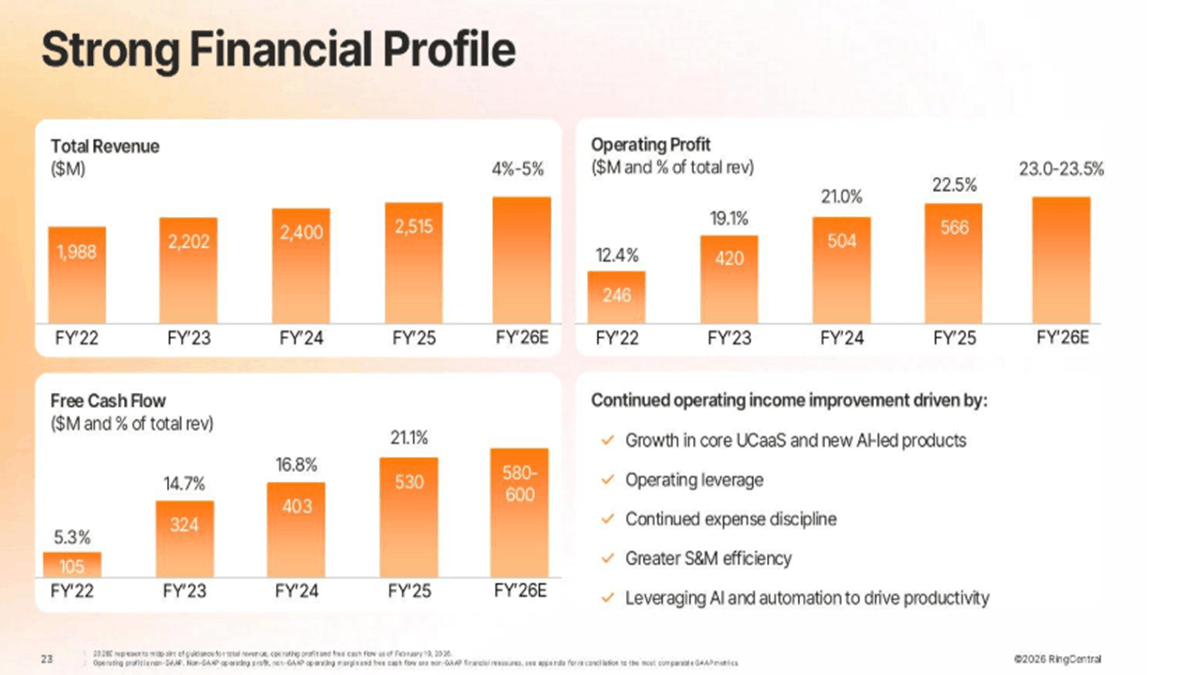
RingCentral closed fiscal year 2025 with $2.52 billion in total revenue, up 4.8% year over year, achieving full-year GAAP profitability for the first time and recording $530 million in free cash flow - up 32%. The company also announced its first-ever quarterly dividend, a signal of financial confidence that matters when you are evaluating a long-term platform partner.
The more strategically interesting numbers are the AI metrics. Two years ago, Vlad Shmunis set a target of $100 million in ARR from new products. At the time, that number was zero. In 2025, they hit it. Customers using at least one paid AI product now represent approximately 10% of total ARR - implying roughly $250 million touching AI applications, a figure that more than doubled year over year. AI-utilizing customers are spending more per seat, staying longer, and retaining at rates exceeding 100% net dollar retention.
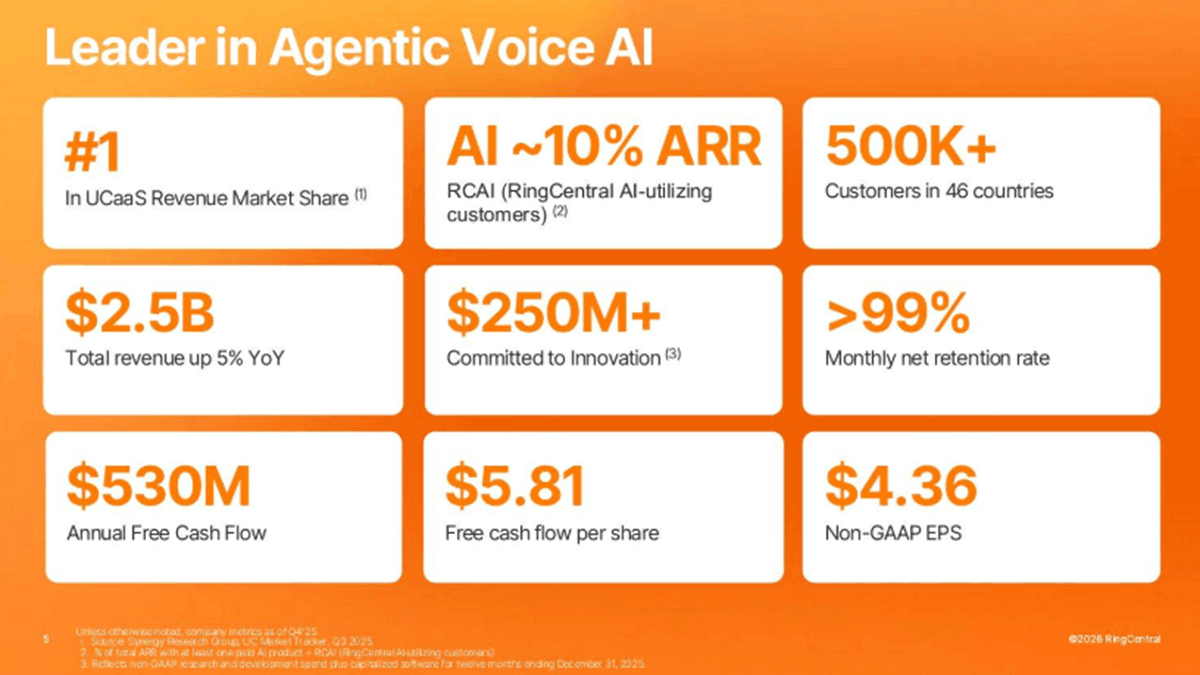 Source: RingCentral Q4 2025 Earnings Presentation, February 19, 2026
Signal 1: Voice Is the Moat - and the AI Opportunity
The most important thing to understand about RingCentral's AI strategy is that it is not built around a large language model. It is built around voice infrastructure. That distinction matters more than most coverage of this company acknowledges.
RingCentral processes more than 35 billion voice minutes per year - over one billion calls per month, across 500,000 customers in 46 countries. That infrastructure, with 99.999% uptime requirements, low-latency architecture, and regulatory compliance baked in across dozens of jurisdictions, is not something you spin up from a cloud credits account. It represents a multibillion-dollar cumulative investment built over two decades.
Any AI agent that needs to make or receive a phone call at enterprise scale will eventually need that infrastructure underneath it. RingCentral's bet is that they are that infrastructure layer - and that as AI agents increasingly handle B2C interactions, the company sitting at the top of that funnel is in an enviable position.
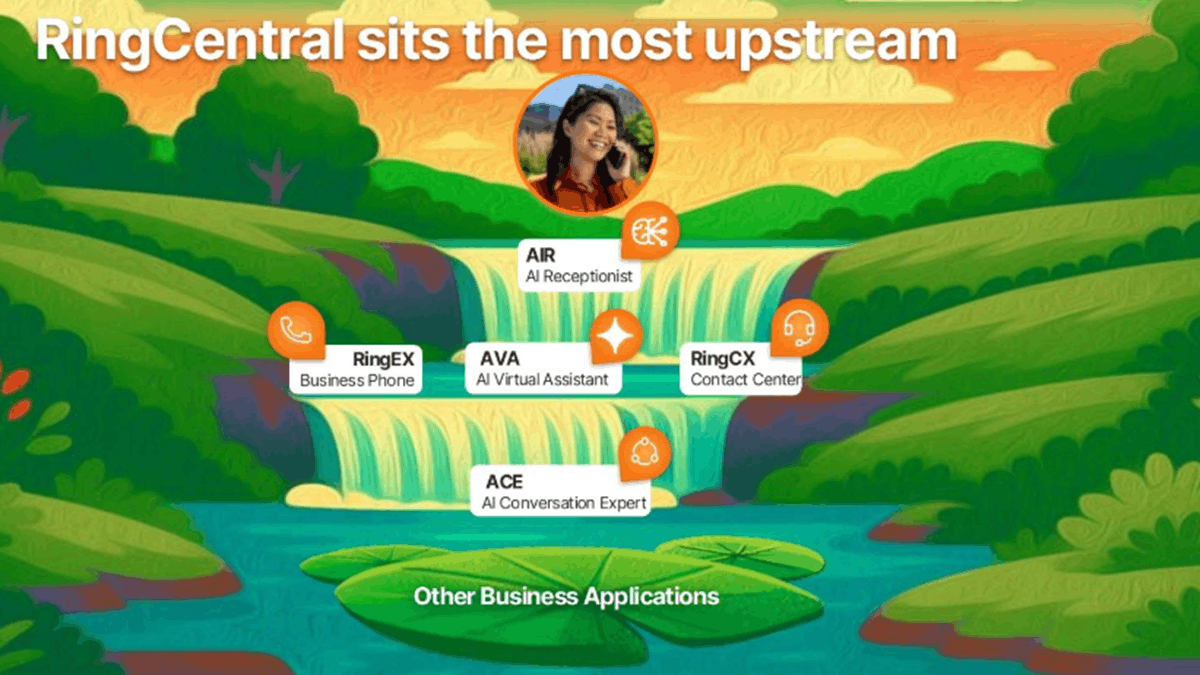 Source: RingCentral Q4 2025 Earnings Presentation, February 19, 2026
That reframe - from the best UC plus CC player in the world to what Carson Hostetter, who leads go-to-market, described at the summit as the agentic voice AI company that also happens to have the best UC and CC platforms - is not just positioning language. The word order matters. AI is not a feature bolted onto communications. Communications is the infrastructure underneath AI.
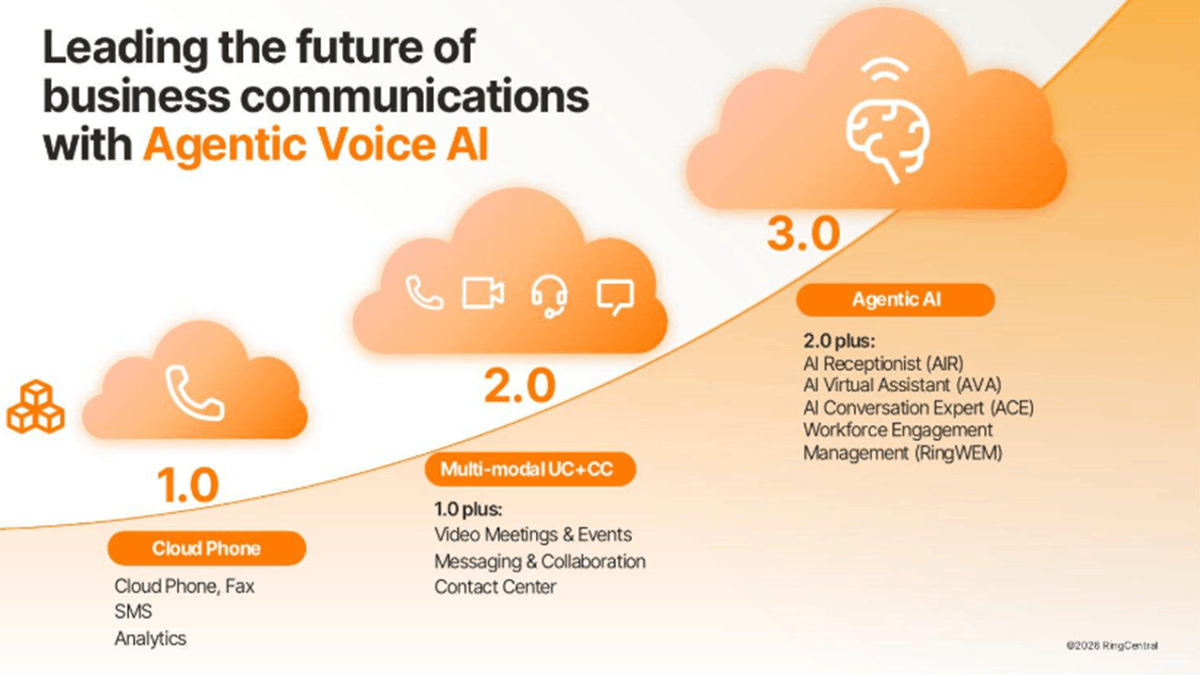 Source: RingCentral Q4 2025 Earnings Presentation, February 19, 2026
The company is spending over $250 million annually on R&D, with approximately 60% directed toward new product innovation. The relevant question for IT decision makers in 2026 is not whether RingCentral's phone system is better than the incumbent's - it is whether your communications platform can serve as the foundation for AI-driven business interactions over the next five years.
Signal 2: The Three A's Are a System, Not Three Products
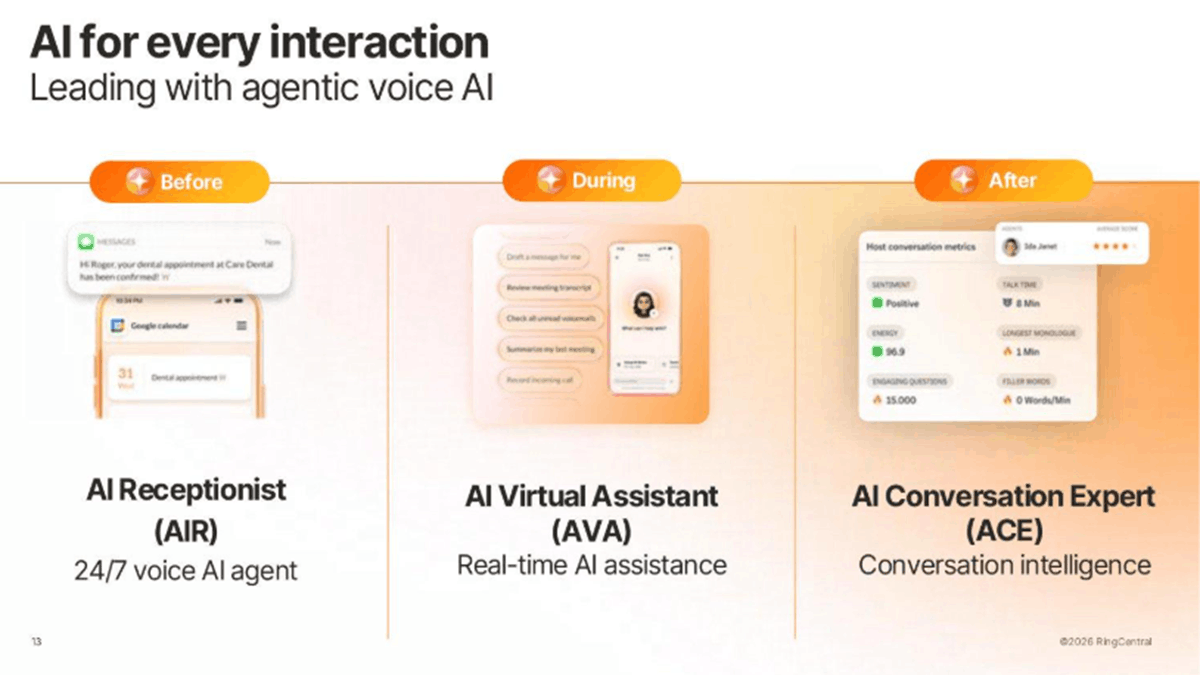
One of the most common mistakes in evaluating AI product portfolios is treating individual features as the unit of analysis. RingCentral has three core AI products - AIR, AVA, and ACE - and understanding them in isolation misses the point. The value case is in how they compound.
 Source: RingCentral Q4 2025 Earnings Presentation, February 19, 2026
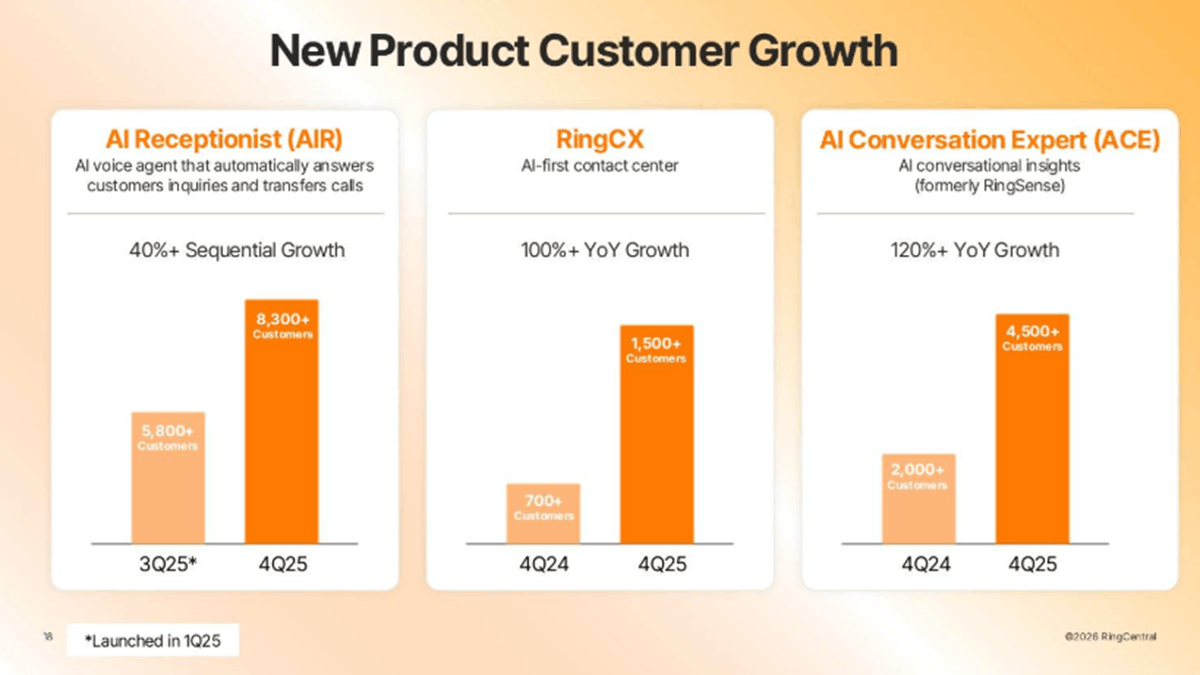
AIR, the AI Receptionist, handles the front door. It answers calls 24/7, routes intelligently, books appointments, and answers questions using the business's own information. No IVR menus. No hold music. AIR ended Q4 2025 with 8,300 customers, up 44% sequentially, running on usage-based pricing tied to call volume rather than seat counts.
AVA, the AI Virtual Assistant, steps in when a call reaches a human agent. It surfaces context, captures notes in real time, and accelerates workflows - the difference between an agent scrambling to recall a customer's history and one who already has what they need before they say hello.
ACE, the AI Conversation Expert, closes the loop after every interaction. It analyzes recorded conversations for quality, coaching, and competitive intelligence. Contact center managers historically reviewed 2-4% of calls by hand. ACE reviews 100% automatically. Customer count exceeded 4,800, up 144% year over year.
The compounding effect is where the business case gets interesting. AIR captures cleaner intake data. AVA uses that context to make human interactions more efficient. ACE turns every interaction into organizational intelligence that improves the next one. AI-utilizing customers are showing net dollar retention rates above 100%, including in small business segments where retention has historically been harder to sustain.
Two products round out the portfolio. The Customer Engagement Bundle addresses businesses with informal contact center needs - shared inboxes, queue management, basic reporting - and channel partners describe it as carrying the highest AI attach rate in the portfolio. For organizations with formal contact centers, RingCX provides the full AI-powered suite. It nearly doubled its customer count to more than 1,500 in 2025, and over half of RingCentral's million-dollar-plus TCV deals in Q4 included it.
 Source: RingCentral Q4 2025 Earnings Presentation, February 19, 2026
The architecture is the same underneath all of it - which is what makes the platform argument credible rather than aspirational.
Signal 3: The Proof Points Have Crossed the Line from Promising to Compelling
The difference between last year's summit and this one was not the products. It was the customers on stage talking about what happened after they deployed. A year ago, RingCentral was showing demos and early case studies. This year, enterprise customers were presenting CFO-level outcomes - and customers have no reason to oversell on your behalf.
Brian Tucker is the Chief Digital Officer of Televero Health, a virtual behavioral health company operating 24/7 across 21 states, serving 85,000 patients annually. During COVID, call volume overwhelmed his organization to the point of near-crisis. After deploying AIR and eliminating their IVR on day one, Tucker reported four points of EBITDA improvement, a 30% improvement in patient care outcomes, and an 11-day cash cycle across all insurance payers - which he described as virtually impossible in behavioral health without AI automation. Televero is expanding from 21 states to 40 by end of 2026, possible only because the AI layer handles operational scaling that human staff cannot absorb fast enough.
Steve Inman, VP of Technology for the Chicago Cubs, manages more than 100 entities - hotel, real estate, rooftop venues, the Chicago Stars NWSL team, and a venture operation, in addition to the ballpark itself. His technology team went from 18 people to 14 while that scope expanded. On cutover day at Wrigley Field, the sales team in Mesa was texting him to say the phones were cool. He had not trained them. Organic, unsolicited adoption by non-technical users is harder to manufacture than any metric.
The proof points extend further: PM Pediatrics deployed AIR, AVA, and ACE across 80-plus locations and is now handling 30% more patient calls. A veterans services organization moved from manually auditing 300-400 calls per month to fully automated audits of 120,000 calls monthly with ACE.
Two patterns repeat across every example. The initial deployment unlocks a second - AIR gets installed, it works, and the customer adds ACE. And the outcomes being reported are not IT metrics. They are business metrics - EBITDA improvement, patient outcomes, cash cycle.
That shift in the level of the conversation is the clearest signal that this AI portfolio has moved past the pilot phase.
Where the Story Is Still Being Written
An analyst's job is not just to amplify signals. It is to filter noise. There are three things about RingCentral's story in 2026 that deserve honest scrutiny.
The revenue growth question is real. $2.52 billion growing at 4.8% is a mature business. RingCentral is guiding to 4-5% total revenue growth in 2026. For a company positioning itself as a transformational AI platform, mid-single-digit growth invites a fair question: is the AI business growing fast enough to offset headwinds in the legacy base? Management acknowledges enterprise pricing pressure from COVID-era contract renewals and expects that headwind to clear entering 2027. That is a reasonable explanation - and one worth verifying over the next few quarters.
The 90% of the installed base that has not yet paid for AI features is both the challenge and the opportunity. Moving from 10% AI attachment to something approaching mainstream adoption is where the growth narrative gets confirmed or questioned.
The product velocity creates real planning challenges. Twelve months ago there was no AIR. Twelve months from now the landscape will look different again. RingCentral operates with deliberate roadmap ambiguity - in their own words, startup-like agility at enterprise scale. For IT leaders building multi-year technology plans, that pace is both a feature and a complication. Evaluate execution track record and financial capacity to invest - not the current feature list.
What's Coming: AIR Pro and the Vertical Expansion
AIR Pro is now official. Kira Makagon, President and COO of RingCentral, announced the product as part of her keynote at Enterprise Connect 2026 in Las Vegas - a fitting stage for what represents a significant step from plug-and-play voice AI to fully configurable, omnichannel conversational AI agents. First previewed at the analyst summit in Scottsdale two weeks prior, AIR Pro is designed for organizations that need to build, deploy, and orchestrate custom AI agents across voice, digital channels, and complex multi-step workflows - without writing code.
AIR is a product you turn on. AIR Pro is a platform you build on.
Healthcare is the first named vertical, and the investment is real. RingCentral integrates with Epic, Athenahealth, and other leading EHR systems, and AIR Pro adds pre-built skills for patient identity verification, appointment management, and clinical workflow routing. The broader ambition - using AIR Pro to build vertical AI platforms across healthcare, legal, and financial services on top of voice infrastructure that vertical AI startups cannot easily replicate - is a credible thesis. Healthcare is the test case. Watch the customer count and depth of workflow automation over the next two to three quarters.
What This Means for IT Decision Makers
 Source: RingCentral Q4 2025 Earnings Presentation, February 19, 2026
If you are an IT leader evaluating RingCentral in 2026, the question is not whether their cloud phone system is better than the incumbent's. It is whether their platform can serve as the AI layer for the business interactions that matter most to your organization.
The financial foundation is solid. $530 million in free cash flow, first-ever dividend, debt at 1.7x net leverage, and over $250 million committed annually to R&D. The platform stability case for a five-year commitment is credible.
The infrastructure moat is real. Carrier-grade reliability, 99.999% uptime, two decades of compliance architecture across 46 countries - this is the kind of foundation that takes years and significant capital to replicate, and it matters more as AI agents take on mission-critical customer interactions.
Evaluate the system, not the products. Map your full interaction footprint before scoping a deployment - every place a customer or prospect touches your business by voice, text, or digital channel. That map should drive your architecture, not the product catalog.
If your organization has teams handling inbound inquiries outside of a formal contact center structure, the Customer Engagement Bundle deserves a serious look. And when evaluating the vendor overall, prioritize execution track record and financial capacity over any two-year feature roadmap - because that roadmap will change.
RingCentral Has a Credible Position in a Contested Market
Alex Stanich was not wrong three years ago about the dynamics he was observing. He was wrong about the conclusion.
What he was seeing was the end of UCaaS as a standalone category - the commoditization of cloud phone, the compression of margins, the race to feature parity. What he could not see yet was what would replace it.
What is replacing it is a communications platform that acts as the AI layer for B2C business interactions. Not just connecting calls - automating the front door, assisting the human in the moment, analyzing every interaction afterward, building institutional intelligence out of conversational data. That is a fundamentally different value proposition than cloud phone, and it is one that RingCentral's 500,000-customer installed base is just beginning to access.
RingCentral is not the only company pursuing this vision. The agentic communications space will be contested. But they enter 2026 with voice infrastructure at scale, AI products in market with real customer proof points, the financial profile to keep investing, and the partner ecosystem to distribute at speed.
Those are not IT outcomes. Those are business outcomes. And that distinction is what separates a vendor with a compelling AI story from one with a proven AI platform.
For IT leaders making platform decisions this year, it is no longer a question of whether to include AI-native communications capabilities in your criteria. It is which vendor has earned the right to be your infrastructure for the interactions that matter most - and that question deserves the same rigor, and probably the same urgency, as your last major enterprise software decision.
Disclosure: Travel and hospitality for the RingCentral Analyst Summit were provided by RingCentral. All financial figures cited are drawn from RingCentral's public Q4 2025 earnings call and investor presentation dated February 19, 2026. Analysis and opinions are independent.
Gain valuable perspectives on AI, collaboration tools, and workplace innovation. Subscribe to our newsletter for expert insights delivered directly to you.