 ·
3 minute read
·
3 minute read
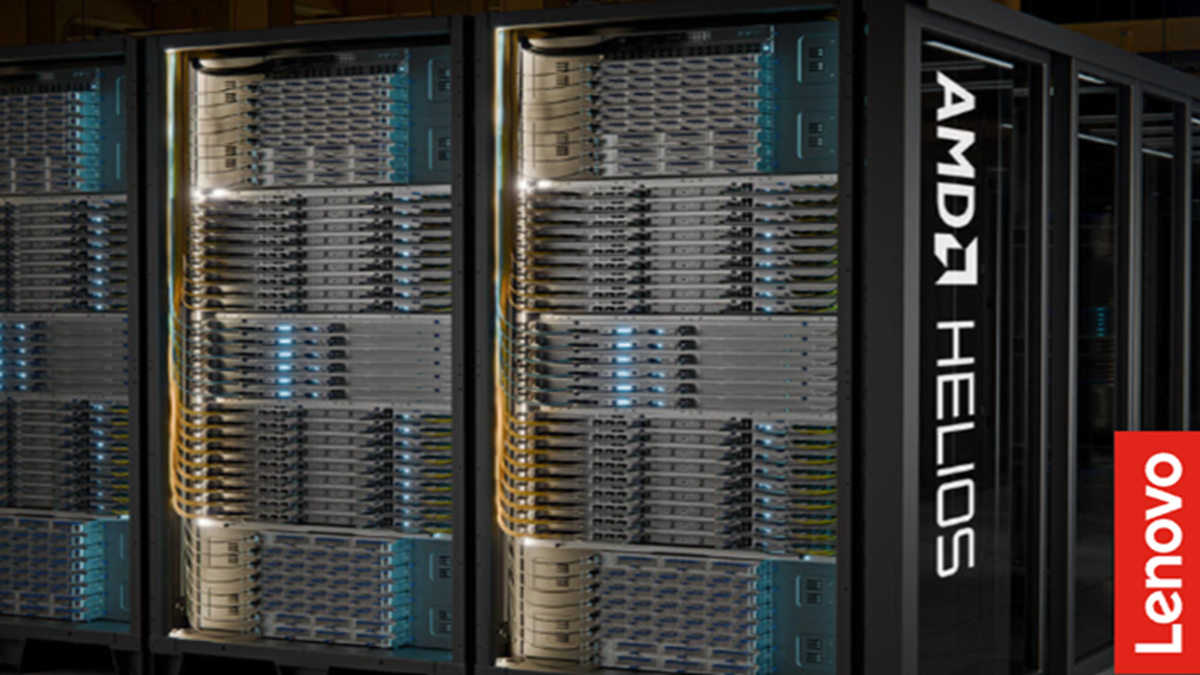
The Brief: Lenovo has announced its adoption of the AMD Helios™ rack-scale solution, becoming one of the earliest OEMs to support the platform for hyperscalers and NeoCloud providers building AI factories.
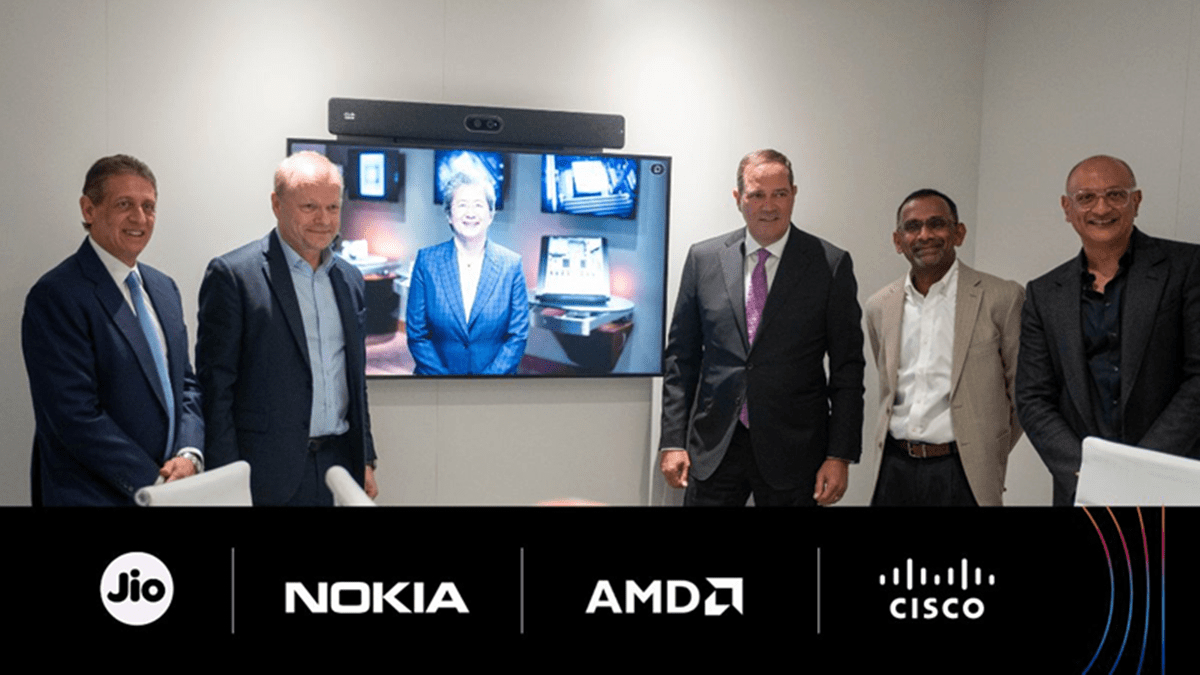
Introduced during Lenovo Tech World '26 alongside AMD Chair and CEO Dr. Lisa Su, the platform combines AMD Instinct™ GPUs, AMD EPYC™ processors, AMD Pensando™ networking technologies, and the AMD ROCm™ software ecosystem within an open architecture based on Open Compute Project (OCP) and Open Rack Wide (ORW) specifications.
A fully configured rack integrates 72 AMD Instinct MI455X GPUs, 31TB of HBM4 memory, and next-generation EPYC processors to support large AI training and inference workloads.
Lenovo will complement the hardware with deployment, optimization, liquid cooling, and lifecycle services. Solutions based on AMD Helios are expected during the fourth quarter of 2026.
See full details of the announcement about the AMD Helios rack-scale solution at news.lenovo.com.
 Source: Lenovo
Lenovo Expands AI Factory Infrastructure with AMD Helios Rack-Scale Solution
Analyst Perspective: The introduction of AMD Helios strengthens Lenovo's participation in large-scale AI infrastructure, particularly among organizations building dedicated AI environments instead of isolated compute clusters.
Enterprise AI investments increasingly involve complete systems that integrate compute, networking, cooling, and software into unified deployments. This collaboration places Lenovo within that transition by contributing engineering expertise alongside AMD's silicon portfolio.
Customers purchasing AI infrastructure also expect deployment services that shorten implementation timelines and improve operational efficiency. Lenovo's experience in infrastructure integration adds value because hyperscale environments require careful planning before hardware enters production. Engineering support can influence utilization rates as much as the underlying hardware.
This announcement also reinforces Lenovo's Hybrid AI direction. By extending capabilities across cloud, enterprise, edge, and hyperscale environments, the company continues building an infrastructure portfolio that accommodates different deployment strategies while maintaining openness through industry standards.
Lenovo Extends Its AI Infrastructure Portfolio With Rack-Scale Design
The AMD Helios rack-scale solution adds a new option to Lenovo's AI infrastructure portfolio for hyperscalers and NeoCloud providers. Instead of deploying separate servers for different tasks, the platform brings computing, networking, memory, and software into a single rack designed for large AI workloads.
Each fully configured rack includes 72 AMD Instinct MI455X GPUs, next-generation AMD EPYC processors, 31TB of HBM4 memory, AMD Pensando networking technologies, and the AMD ROCm software ecosystem.
It is built on Open Compute Project (OCP) and Open Rack Wide (ORW) standards, and it supports compatibility across modern data center environments. Lenovo also provides engineering expertise and deployment services to help customers design, install, and optimize AI infrastructure for model training, fine-tuning, and inference, making it easier to move AI workloads into production.
Deployment Services Become a Greater Differentiator for AI Infrastructure
Lenovo's announcement is about more than introducing new hardware. It also emphasizes the company's deployment and support services, which help organizations build and operate large AI environments.
Setting up AI infrastructure requires careful planning for networking, cooling, GPU configuration, workload distribution, and overall system management before workloads can move into production. Lenovo works with customers to assess their AI requirements, optimize system performance, implement liquid cooling where needed, and provide lifecycle services after deployment.
The company also helps design AI clusters that fit specific workloads instead of using a one-size-fits-all configuration. This support can reduce deployment time, improve GPU utilization, and simplify ongoing operations. For organizations making significant AI investments, having experienced infrastructure and deployment services is becoming just as important as selecting the right processors and AI accelerators.
Open Standards Support Long-Term AI Infrastructure Planning
AMD Helios is built on open specifications from the Open Compute Project (OCP) and Open Rack Wide (ORW), allowing organizations to design AI infrastructure with greater flexibility.
Using open standards makes it easier to integrate different technologies and reduces reliance on proprietary systems. This gives customers more options as their AI requirements continue to change. Lenovo's support for this ecosystem also fits the growing demand for infrastructure that can accommodate generative AI, agentic AI, and large foundation models without requiring a complete redesign.
Combined with Lenovo's Hybrid AI strategy, the platform enables organizations to deploy AI across enterprise data centers, cloud environments, edge locations, and hyperscale facilities while maintaining a consistent operating experience across those environments.
Looking Ahead at Lenovo's AI Infrastructure Strategy
Lenovo continues investing across servers, edge computing, hybrid cloud, liquid cooling, and AI infrastructure, making the AMD Helios collaboration a logical addition to its existing portfolio.
As organizations move toward dedicated AI factories, customers increasingly seek integrated solutions that combine hardware, deployment expertise, and operational services within a single engagement. This announcement addresses that demand while supporting hyperscalers and NeoCloud providers building high-density AI environments.
Operational Considerations
Deploying rack-scale AI infrastructure introduces planning requirements involving power availability, cooling capacity, networking readiness, software optimization, and long-term operational management. Organizations without sufficient preparation may experience delayed implementation or underutilized GPU resources.
These concerns can be reduced through detailed workload assessments, infrastructure planning, and lifecycle services before production deployment.
Future Direction
Demand for AI factories is likely to increase as enterprises deploy larger foundation models and agentic AI applications.
Lenovo's continued investment in open infrastructure, engineering services, and Hybrid AI technologies places the company in a strong position to support organizations building increasingly sophisticated AI environments while maintaining deployment flexibility across multiple computing locations.
Looking for trusted voices to shape conversations on workplace collaboration? Schedule a call with the Collab Collective today for expert commentary or speaking engagements that bring clarity and impact to your audience.