 ·
8 minute read
·
8 minute read
Summary
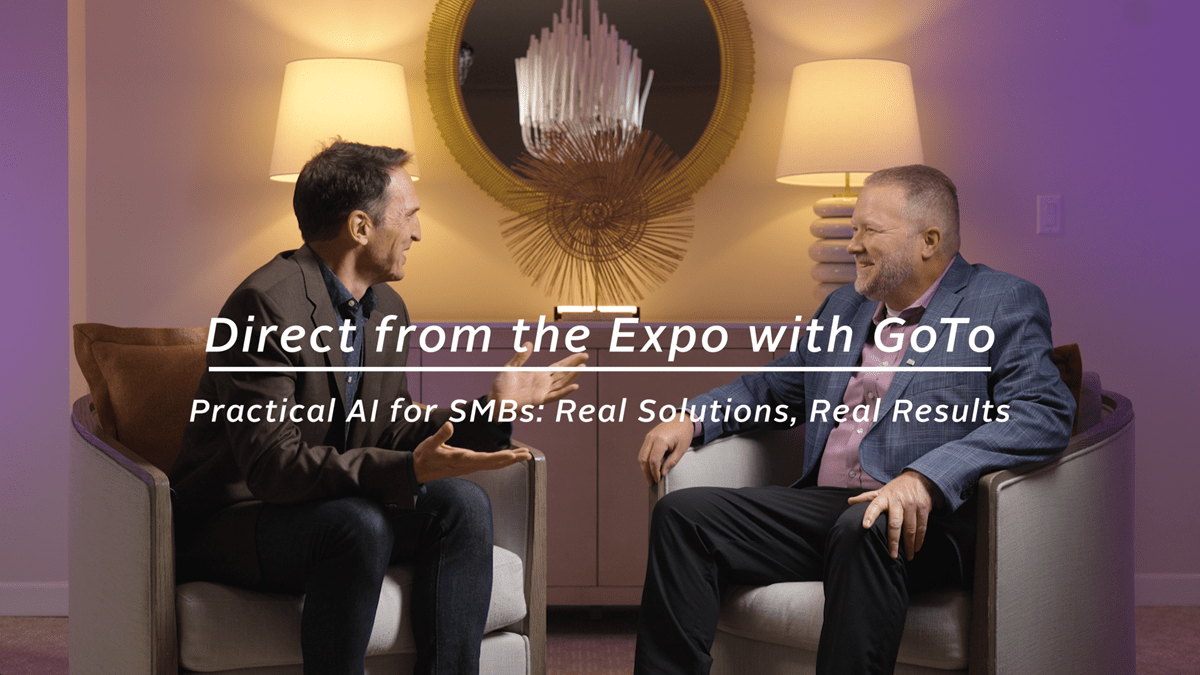
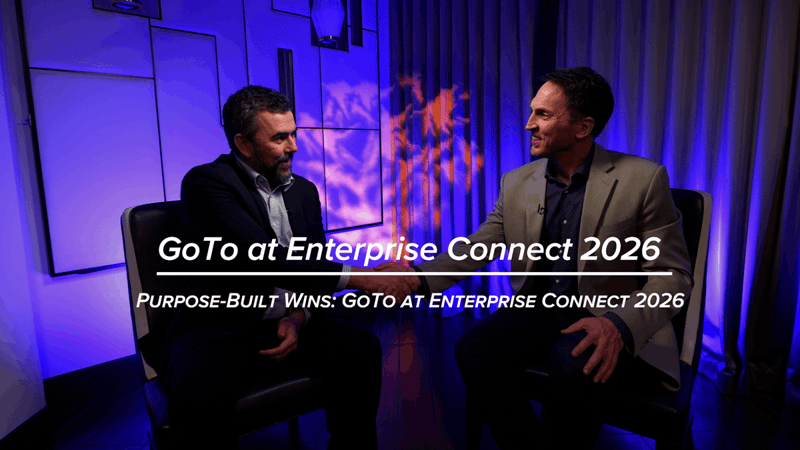
On this episode of Direct from the Expo, the Collab Collective’s Craig Durr speaks with Malachi Threadgill, VP and Head of UCC Marketing at GoTo. Recorded live at Enterprise Connect 2026, the conversation explores how GoTo is expanding its vertical strategy across automotive, education, and healthcare with purpose-built unified communications solutions powered through embedded AI, and how the company approaches industry-specific challenges through a platform designed to simplify communications, support operational efficiency, and create new opportunities for partners delivering business value.
Their discussion covers:
- Practical AI in UCC: How GoTo focuses on embedded, purpose-built AI that supports real operational workflows instead of flashy standalone features
- GoTo Connect for Automotive Growth: Adoption across more than 3,500 dealership rooftops and how AI Receptionist helps reduce missed calls and drive revenue opportunities
- AI Receptionist Enhancements: New scheduling capabilities that allow customers to interact with dealerships anytime while freeing staff to focus on higher-value work
- Purpose-Built Vertical Integrations: Expanding integrations with dealer management systems, CRM platforms, and industry tools to deliver a unified “single pane of glass” experience
- Education Industry Strategy: How GoTo Connect for Education addresses budget constraints, lean IT teams, and safety requirements through affordable, integrated communications tools
- Healthcare Expansion: The introduction of GoTo Connect for Healthcare and the opportunity to support small to mid-sized clinics through AI-enabled communications and healthcare system integrations
- Channel and Partner Opportunities: Why vertical specialization creates new opportunities for partners to demonstrate business value beyond traditional IT-focused UC deployments.
Listen to the Audio:

Or tune in on your preferred streaming platform:


Transcript
Craig Durr: Everyone, this is Craig, our chief analyst and founder of the Collab Collective. And I want to welcome you to another edition of Direct from the Expo at Enterprise Connect. I'm really excited about today's guest because actually, we sat here at Enterprise Connect in 2025 and visited the company as well. And a lot has happened in the last year. So I'm happy to introduce to you Malakai Threadgill, VP, Head of UCC Marketing for GoTo.
How are you doing?
Malachi Threadgill: I'm doing great. Thanks for having me.
Craig Durr: I'm glad to have you here. A year ago, one of the key ideas that we talked about as we sat in these chairs with your colleagues was—you wanted to do AI that wasn't flashy, it’s practical AI that was purpose-built. Now, looking back over a year and all the things we're going to talk about, it looks like that was part of a larger strategy. Is that a fair statement?
Malachi Threadgill: Absolutely You know, everyone is talking about AI. You can't get away from it. What we really wanted to do is when we think about our platform that we've talked about before and will continue to talk about is if everyone has disjointed AI in a disjointed platform, it doesn't work. So we really wanted to focus on how we can truly embed AI and our all in one solution to make it beneficial for everyone that uses our solutions.
Craig Durr: Well, let's talk about that one hero product that I really love talking about, which is GoTo Connect for Automotive because that's what we announced here last year. That product seems to be very well received so far. Tell me about how that's been in the last year.
Malachi Threadgill: Yeah, it's been really exciting to just see how the solution has transformed these dealerships. We're already at 3,500 plus rooftops. And we're seeing massive win rates in terms of when dealers see the solution all in one piece, the single pane of glass, they get really excited to think about how that can help them transform and ultimately provide better service for their customers.
Craig Durr: Okay, but you haven't even sat on your laurels. You launched in March and you've continued to add to this, and it really feels like the platform significance of it shows. In October, you took a cornerstone feature of yours, AI Receptionist, and you added scheduling functionality to it. Tell me about that and how this vertical has adopted that.
Malachi Threadgill: One of the things that has become evident to me, and getting to know this space a little bit better is that the dealers, the principals of these organizations, know exactly how much this phone call costs. Down to the tee. So if you think about that and you think about the benefits of what AI Receptionist gives you—there's no more wait times, there's the ability to call at any hour of the day. And all of this can be processed so that the end user or the customer can choose how they want to interact with the dealer, you may want your staff focused on more important things than having to sit there and answer phone calls all day long.
Craig Durr: Right, but that missed phone call and the cost for that, it sounds like this is really taking this from just a communication tool to a business enabler in a lot of ways.
Malachi Threadgill: Yeah, one hundred percent. I think we're seeing this force multiplying effect in terms of where your back office systems are today, when you layer on AI, they can be proactive and they can actually become front office systems that generate more revenue for the business.
Craig Durr: Well, that leads into the next update you guys did in January of this year. You went a little bit deeper in terms of some specific automotive technologies, DMS or
Dealer Management Systems and CRM programs. Was this part of the plan?
Malachi Threadgill: Yeah, it has been part of the plan. You know, we've been building out that automotive expertise. Even before we created the automotive skew, we saw that we had a swell of customers. So we asked them what they wanted, and when you sit down and ask them what they want, you get good insight.
We really started to build out, and they wanted a single pane of glass. So it's not just an integration into CRM, it's an integration to Techon, it's an integration of Cox, etc.. By building out these integrations, we make it easier for them to be where they need to be, but the omnichannel capabilities with AI on top makes everything seamless.
Craig Durr: So what I'm hearing here is kind of a platform play. And what's interesting to me is how you’ve been taking these learnings, or maybe it was part of the master plan, and applied it to this next vertical that you launched in October. I want to get up to speed on GoTo Connect for Education.
Now, before you dive in, there's some key things as an analyst that I think about, you know. This is a budget constrained vertical. This is very lean IT staff. They even have special needs, requirements around safety concerns. How did you address these pain points with that playbook?
Malachi Threadgill: Same thing we did with automotive. From the history of GoTo back in the jive days, we had a high win rate in the education space. And so when you think about where we do have that high win rate, you ask them what their problems are and you learn. We continue to build this out.
Seeing the success in automotive skew, we're able to extend that—the benefit of our all in one platform and how we've built it means that we can give them affordable solutions. And understanding the seasonality of their buying really helps us hone in on when they are going to make these decisions and how we can add those capabilities, the safety features that everyone cares about.
So that skew becomes purpose-built to help these school districts be able to afford a solution that is practical, pragmatic and affordable.
Craig Durr: Let me double click on that a little bit. This safety requirement seems like a really good opportunity to differentiate what you're offering there. Is that the plan? Tell me what you've done in that regard.
Malachi Threadgill: You know, it becomes table stakes, the E911, those types of things, for someone who wants to go and pursue the vertical. The emergency alerts are very important in terms of having those types of capabilities. So we thought, let's just build out what they need in order to be successful. I don't want to claim it's rocket science or anything there. It's pragmatic. But when you build a pragmatic skew for a vertical that needs something that's affordable, reliable, it just works.
Craig Durr: And what you talked about dealing with their budget constraints, I like that. It almost creates an element of predictability in terms of what they're doing, in terms of their billing cycle and planning cycle.
Malachi Threadgill: Yeah, absolutely. I think when you look at the constraints that the education industry faces, why should they be paying a premium on a phone system? They can invest those dollars in other more important tech that can actually help educate their students. So we made it intentionally affordable for them.
Craig Durr: So we've got automotive, education, and that brings us today. This week at Enterprise Connect, GoTo made an announcement of another vertical that it's entering into. This is GoTo Connect for Healthcare, right? I want to know more about this. Tell me about the announcement.
Malachi Threadgill: Just copy pasting the playbook, right? When we look at a customer base, we ask our cab what they want, and we get really good insights. It starts with the all-in-one platform. When you layer in purpose-built integrations into Athena, you build them into all of the other healthcare systems, and then you layer on AI, you see massive success. And so we're really excited about where we're going with this. Just having launched the skew, I think that there's going to be some general excitement about the industry.
Craig Durr: Well, let me play devil's advocate here. This is very large vertical. This is much larger than automotive or even education, and there's a lot of competition there, right? So the question is what's the opportunity for GoTo to find its market within this very competitive vertical?
Malachi Threadgill: By our calculations, there's over 650,000 accounts or practices, clinics, etc. The vertical is very large. We want to hone in on where we do well okay. Historically, we've done well on the small, medium-sized businesses focusing on those practices 25 to 500 employees typically.
We also want to focus on the clinics, the primary care physicians… We think that that is our sweet spot. These are practices that are trying to evolve from just they're on-prem, they have 7 or 8 point solutions as well. So if we can combine all of that for them, make it affordable, we think that we can help them win, and we think that they can provide better patient care with, once again, just like automotive, if they have a single pane of glass, they're able to focus on their patient outcomes. The patients are less stressed when they're trying to call in. If they have to wait for a long time and they're scared, or if they want to check on their prescription, they can go through the AI Receptionist and use that as well.
Craig Durr: That's fantastic. I love this solution. All right, so what I hear you saying is that this purpose built solution finds its right audience in this larger healthcare market.
Malachi Threadgill: One hundred percent. You know, the health care space is so large, and there've been many announcements even last week at Enterprise Connect about companies that want to go into the healthcare space. In fact, Enterprise Connect was during the HIMSS conference, which is serendipitous.
But the space is so large that it's not going to be one-size-fits-all. There's going to be these point solutions, and it's not one winner—there's multiple winners in this space. Ultimately, if we provide great solutions that help clinics take care of their patients, everyone should win.
Craig Durr: It sounds like a win-win situation. All right, I love it. So let's go ahead and start wrapping it up here. So if people want to find out more about any of these vertical solutions, what should they do?
Malachi Threadgill: Just go to the website. Look at us on social media. If you can go, click the link right below, and you can see the go to healthcare announcements there. But also look at the other verticals that we have and be on the lookout for more announcements coming soon.
Craig Durr: Okay. That's good to know. Now, also, what about channel partners that might be interested in learning more about working with GoTo?
Malachi Threadgill: We're super excited about channel partners. My background has been in the channel for a very long time, and I'm really excited about how we can educate our channel partners to do better, and how they can evolve their business.
Historically, the channel sells primarily to the IT buyer. As you go into automotive, as you go into healthcare and other verticals, you can't just sell through IT—you have to show the business value. So being able to help our partners understand how they can deliver business value in these verticals, it's a win-win all around.
Craig Durr: Well, you've got the proof points, especially in these last couple of vertical solutions that you've launched already.
Malachi, I want to thank you for this update. This has been fantastic. A lot of great information you share. Not only have we seen these proof points around the previous solutions you launched, but now we have a healthcare market and I'm looking forward to checking back with you guys in a year to see where have you gone from there.
Everyone, this is Craig Durr, Chief Analyst at the Collab Collective. We are here Direct from the Expo at Enterprise Connect 2026. Stay tuned and get some more updates along the way. Take care.