 ·
11 minute read
·
11 minute read
Summary
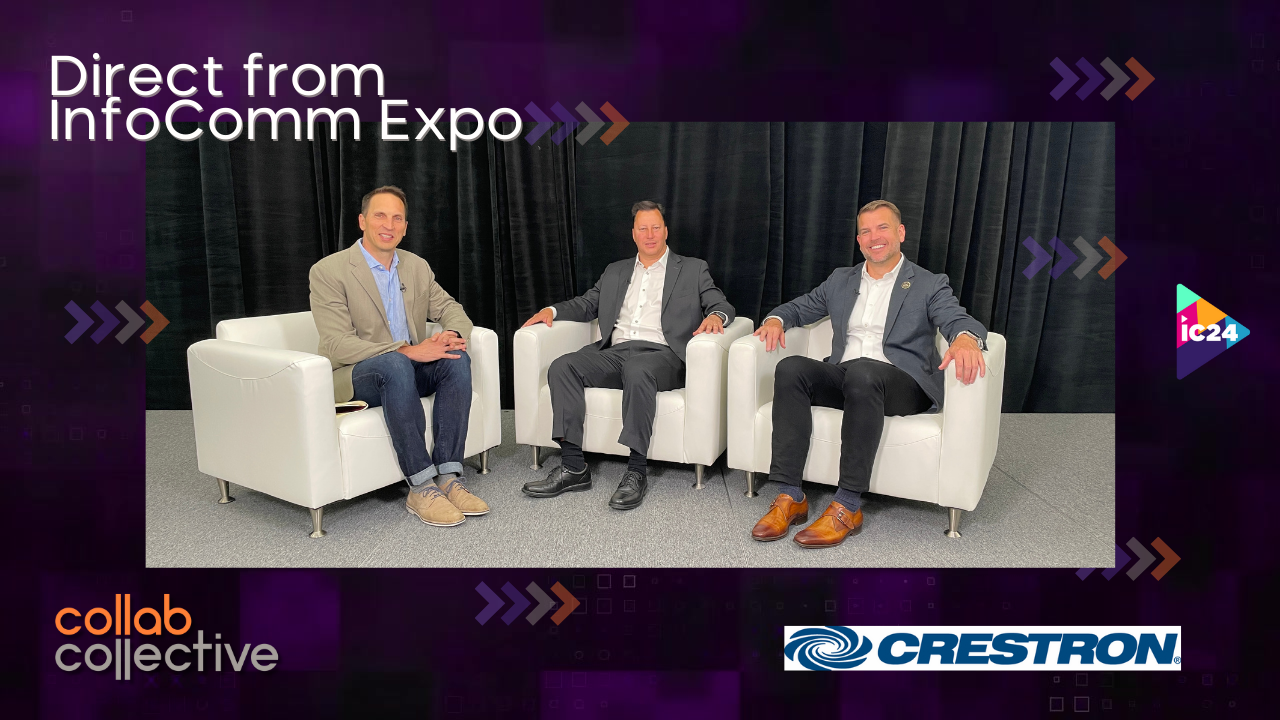
On this special edition, the Collab Collective’s Craig Durr speaks with Crestron leaders Brad Hintze, Alex Peras, and Joel Mulpeter at the True Blue Summit in Barcelona. Recorded live at Camp Nou, the conversation examines how Crestron is shaping collaboration experiences through intentional design, scalable deployment, and an ecosystem-based approach that supports both users and IT teams. They connect the vision behind exceptional spaces with the engineering framework and product strategies that enable consistent, enterprise-ready hybrid work environments.
Their discussion covers:
- Exceptional Spaces as the New Standard: Why hybrid work has raised expectations and how collaboration experiences must fade into the background so teams can focus on people and outcomes
- Collaboration Fueled by Culture: How Crestron aligns technology with productivity, efficiency, and organizational culture instead of focusing on individual devices
- Deploy, Core, and Peripherals Framework: A clear architectural model that supports fast installation, repeatable deployments, and flexibility across thousands of rooms
- Engineering for Scale and Intelligence: How edge compute, integrated audio and video, and network-based architectures support consistent experiences for enterprises and integrators
- New Crestron Solutions at True Blue Summit: A walkthrough of five unveiled offerings, including Collab Compute, 80 Series Touch Panels, the 1 Beyond i12D camera, DM NAX Intelligent Audio, and Auto Measure for Automate VX
- Enterprise-Ready Collaboration Platforms: How tight alignment with Microsoft Teams Rooms, Zoom Rooms, and Microsoft MDEP supports security, manageability, and long-term deployment strategies.
Listen to the Audio:
Or tune in on your preferred streaming platform:


Transcript
Craig Durr: Hey, you made it. I am so excited you’re here. Come on up. I got something to show you. Let's go.
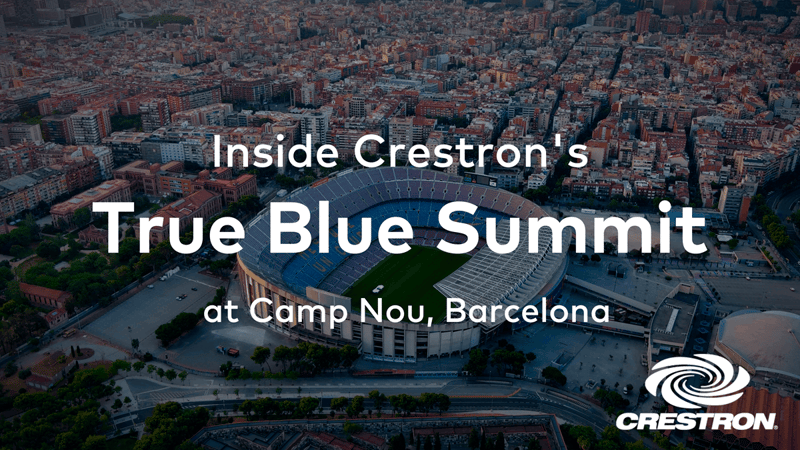
Can you believe it? They did it again. Crestron brought us to another incredible place for another incredible event. This time we are in Camp Nou in Barcelona. You know the place. This is the legendary stadium of FC Barcelona. A hundred thousand people go into this arena, and right now, we've got this entire area for this Crestron event. But I'll tell you what the best thing is taking place backstage, and I'm going to take you back there before these guys go on before their True Blue Summit. So come with me to check it out. Let's get behind the stage door.
Brad!
Brad Hintze: Oh, hey, Craig.
Craig Durr: How's it going?
Brad Hintze: Great
Craig Durr: This is incredible. FC Barcelona, Camp Nou. Crestron is doing another incredible event here.
Brad Hintze: It's the only way to house 400 of your closest friends.
Craig Durr: You are about to go on stage right now, and I want to kind of get a preview. What are you going to be talking about? So you've been talking to a lot of customers. What are you hearing?
Brad Hintze: Obviously, the biggest topics are, everyone's coming back to the office but with much higher expectations, hybrid work has matured, and it's clear that good rooms are not good enough. They need to truly be exceptional.
Craig Durr: Exceptional—that's a pretty high bar you're saying there. Well, tell me, what does exceptional mean in the voice of a customer?
Brad Hintze: Well, I think for everybody, it's the kind of space that just works for you on a Monday morning. You can come in, hold your meeting, have great conversations, and you don't need to worry about any of the technology.
Craig Durr: So collaboration, I actually saw something you were going to talk about before. Collaboration is being fueled by culture. That's a big statement, but what does that mean to you?
Brad Hintze: Typically, our industry likes to just talk about black boxes, but at the end of the day, we want to focus on the outcomes that we're driving, and that is productivity, efficiency, and a culture that enables collaboration for an organization. So connecting that outcome with the technology is really where we're trying to focus.
Craig Durr: So that use case, the technology almost fades away. It becomes invisible, right?
Brad Hintze: Well, it needs to be so that you can just focus on the relationships and focus on the work rather than the technology.
Craig Durr: But you got some great partners that you're talking to about this as well, right? They have that same type of vision as you.
Brad Hintze: We'll be speaking with Microsoft, and I think one of the really interesting points they're going to share is just this concept that for organizations today, so much IP gets generated in a meeting, as well in those ad hoc meetings that take place in the spaces. So how can you leverage that infrastructure to capture that IP, feed it into a broader context, and really drive the organization to be more productive?
Craig Durr: I love it, so let me make sure I got this. Spaces have to be exceptional, collaboration fueled by culture, technology becomes invisible. Am I kind of capturing the vision we're talking about?
Brad Hintze: That's the vision.
Craig Durr: I love it.
Brad Hintze: Alex will cover how we're engineering for that, and then Joel will run you through some products.
Craig Durr: Perfect. I see Alex back there. I'm gonna say hi to him. Good luck on stage, or should I say, break a leg. We'll talk to you later.
Brad Hintze: Thanks, Craig.
Craig Durr: Hey, Alex. Oh my gosh, this is so exciting. How's it going?
Alex Peras: Great. How are you doing?
Craig Durr: You got 400 people out there waiting to hear what you have to say right now.
Alex Peras: It's really awesome.
Craig Durr: You know, Brad shared with me what I would call the vision, the “why,” but he told me, you're gonna tell me the “how.” I mean, this vision, how do you engineer for that?
Alex Peras: Well, it doesn't happen by accident. It happens when we're designing for intention. We really want to make sure that we're delivering intelligence bases to our customers so the technology is effortless and seamless for how they use it.
Craig Durr: You know, I saw some of the language you're using, and I love it. You have a great framework: deploy, core, peripherals. Help break this down. What does that mean?
Alex Peras: Deploy is all about scale and being fast to install and easy to manage. Then, we have the core, which is the intelligence at the edge. That's our computes, our touch interfaces, our audio and video products, all coming together to really drive the deployment. And then peripheral is all about bringing the ecosystem together so that no matter the use case, no matter how many spaces you're deploying, you can really make sure that you're deploying with core and peripheral together.
Craig Durr: I love it. Now, not only customers out there, but you also have integrators. You have partners out there too. How does this speak to them?
Alex Peras: Well, they're not installing one space, they're installing thousands of spaces. And with those spaces, they need to make sure that they're providing predictable solutions to their customers, and they have a trust as they're going to install. And because we're designing with intention, they can go out there with that trust.
Craig Durr: I love it, the themes coming through here. Here's one more thing. I love that you talk about this. This is not just an investment in AV, but this is actually an investment in AI. Tell me, how do those two bridge together?
Alex Peras: We're living in the AI sensory network, where audio, video, compute—everything's coming together and feeding platforms like Microsoft Copilot and Zoom AI Companion, driving, better transcription, better meeting recaps and all of that just gives a better user experience.
Craig Durr: So better data input makes for a better experience in terms of your AI. I love it. It comes together. Now, we're talking about all this happening today. This isn't future tense, right?
Alex Peras: This is real, right now.
Craig Durr: All right. What are you excited to share with people out there?
Alex Peras: We have five amazing solutions that we're just unveiling: the Collab Compute with our new 80 Series Touch Panels. We also have the 1 Beyond i12D, as well as Auto Measure with Automate VX 6.5. Lastly, I'm really excited about this one, our new DM NAX Intelligent Audio Platform.
Craig Durr: This is exciting. All right, so I got the “why,” and I got the “how.” I think Joel is going to show me the “what” and preview those products for me right now. I'm gonna leave you here. Good luck getting ready for this. It's a great crowd. You can have a lot of fun.
Alex Peras: Thanks.
All right, I'll talk to you later.
Craig Durr: Joel, this is incredible. You guys have this entire museum to yourself to show these products off, right?
Joel Mulpeter: We do, yeah.
Craig Durr: I was backstage before Brad and Alex presented, right? Brad walked me through the vision. He told me the “why,” and Alex told me the “how.” He said, “This is how we're going to engineer a culture of collaboration.” But you're going to tell me about the “what,” right?
Joel Mulpeter: Yeah, exactly. We're going to dig into five products that are just down that hallway. We're going to frame around that idea of deploy, core, and peripheral.
Craig Durr: Well, what does that mean to you? I want to hear that.
Joel Mulpeter: Deploy is really about how we create products that can be deployed at scale, that allows us to put that core experience in more spaces, and then ultimately, we want to have the right peripherals that allows every space to have its uniqueness and match to its workflow.
Craig Durr: I love it, so we get to see it before everyone else does right?
Are you guys ready? Let's go, come on.
So this is the very first one on the list. This is Collab Compute, right?
Joel Mulpeter: Exactly. This is Collab Compute. This is our purpose-built hardware made for professional AV to deploy Microsoft Teams rooms and Zoom rooms consistently across many, many spaces.
Craig Durr: Now, this is built for enterprise at scale, though, right? Tell me more about it.
Joel Mulpeter: Yeah, right from the point you unbox it and you go to install it, it has this wonderful bracket that makes the installation nice and easy. It has all the right IO on it, on the back plane, so that you can connect all the right displays, peripherals, input from content sources, and networking connections as well. So really built for deployment.
Craig Durr: But this is also built for AI, right? Tell me about that.
Joel Mulpeter: Yeah, so we're running Intel Core Ultra processors in the Collab Compute. So the Intel Core Ultra 4 and the Intel Core Ultra 7, both of those made for those AI workloads. They have the dedicated MPU cores really made to take on today's AI workloads and what's coming in the future as well.
Craig Durr: So you're saying this is almost future ready. This, right here, is an investment today that's going to last for a lifetime of AI.
Joel Mulpeter: Exactly. It's ready to take on all that Edge AI compute that today, a lot's done in the cloud, but as our shifts towards the Edge, we're ready to take it on for today and tomorrow.
Craig Durr: So here we have the brains, but, but tell me, how are people going to interact with this?
Joel Mulpeter: They're going to do that through our 80 Series Touch Screens, which are just behind you.
Craig Durr: These are beautiful. What is the story behind these?
Joel Mulpeter: These are our 80 Series Touch Screens. The way we look at meeting spaces today, we took a step back and we tried to understand, “What are the common touch points for someone that uses a modern meeting space?” It really starts outside the room with scheduling, right? You walk in and touch a scheduling panel, you understand what the schedule is in the room. Then when you go into the room, it usually starts with, typically UC applications, something like Microsoft Teams rooms on a dedicated UC panel. And then obviously, Crestron, we do a lot of control there. We automate spaces, so room control is super important. Then, we want to have options for doing room control in the spaces.
Craig Durr: So we're talking one series of devices serving all three use cases, right?
Joel Mulpeter: Exactly. One platform in a common way.
Craig Durr: And then you have these great synergies. You're talking about the same cable connect, the same underlying technology.
Joel Mulpeter: Yeah, these are all PoE-powered, so you can really swap them out and use them in all the different colors and sizes and use cases. If you look at things like the scheduling panels, the light bars built into the side, and we have great mounting options for them as well. And this whole platform is built on Microsoft MDEP.
Craig Durr: Oh, that's really important. So Microsoft MDEP, that helps talk about security enterprise manageability, right?
Joel Mulpeter: It does, yeah. We deployed, or we created these products on MDEP because we wanted to have that security posture that we know our end customers are looking for. We know MDEP can help us to deliver that.
Craig Durr: You know, one of the things I'm hearing, which is really important, is that IT security teams are becoming more and more involved with those AV decisions and deployments, right? So the Microsoft MDEP commitment comes to life here, and that helps, serves both of these purposes, right?
Joel Mulpeter: It does.
Craig Durr: This is great. Okay, so two of the five, let's go see some of the other ones.
So now we're at the other part of the framework, peripherals, right? This is the 1 Beyond Camera. This is beautiful. Tell me about this.
Joel Mulpeter: It is. It's the latest addition to our 1 Beyond lineup, the i12D.
Craig Durr: Okay, two cameras. What am I seeing here?
Joel Mulpeter: You're seeing a camera that sits right in between that single lens up to that multicamera. Sits right in the middle, where we have multiple lenses in the 1 device. We have features like speaker tracking, group, framing, composition… all those things built into one. It’s simple to deploy.
Craig Durr: This is one perfect for the platform that's in between either a single PTZ or the larger Automate VX solution, right?
Joel Mulpeter: Yeah
Craig Durr: But you can actually pair these with other ones as well, right?
Joel Mulpeter: You can,just like we do on our other i12 products, the i12D has the same feature set where we can extend to other cameras as well. So over the network, we compare other 1 Beyond cameras with it, and then you get different angles, different views from the room. So if you have a presentation area, where you want to capture the back of the room, you can do all of that with those additional cameras.
Craig Durr: And so this right here is built for that intelligence platform. So not only do we have two mechanical lenses on top, but I noticed down here also we've got a room view camera.
Joel Mulpeter: We do. So there's three total lenses in this device, and all three are active in the call. When we're in speaker tracking mode, it's using the two heads to do speaker tracking as people talk around the room. As people stop speaking for a moment in time, we start to use that wide angle lens to capture the whole room. When we do things like picture in picture, same thing. We have the picture in picture of the wide angle of the room. It's this small camera down the bottom. Otherwise it's the moving heads doing what they should.
Craig Durr: I love it. This is fantastic. To go with this new camera within the video element. What do you have in the audio element?
Joel Mulpeter: We have a whole new audio platform to talk about. We have the DM NAX intelligent audio. This is an ecosystem, or a platform of devices that are made to scale again, from that huddle right up to high impact space.
Craig Durr: Wow. What am I seeing here on the table with it right now?
Joel Mulpeter: You're seeing the core of the system, which is this hub or this processor. It's the audio processor, the DM NAX audio processor. This is what everything connects to. Then you have devices that sit inside the room as well, so we have things like mic pods. This is our mic and speaker pod. We also have things like PoE speakers that we compare with this. But the whole system is built off a network-first architecture, leveraging our AV over IP.
Craig Durr: Which speaks again to that scalability story that we've been talking about in the past, right?
Joel Mulpeter: Exactly. Yeah, to add more devices to this, you simply add more pods. There's a limit of eight pods per room, but if you want to do one room with two, another room with three, another room with five, same processor every time, just simply add the pods that are required for that space.
Craig Dur: This is cool. What is that I'm looking at back there?
Joel Mulpeter: This is our Auto Measure cube.
Craig Dur: This is part of the deploy part of the story?
Joel Mulpeter: It is. This is an Auto Measure cube. It's a feature we added to Automate VX that we call auto measure, and what you do is you mount these cubes inside of the room to the microphone. These have codes on them. These are ArUco markers. The cameras then detect these ArUco markers, and the space measures itself. Instead of you having to do manual measurements about where all the cameras and the microphones are, simply mount these, hit the auto measure button and the room will measure itself.
Craig Durr: Well, you know what? They just dim the lights on us. I think it means everyone’s coming in here right now, right?
Joel Mulpeter: I think so.
Craig Durr: I'm excited for this right now. I can't wait for everyone to see these products right here. Come on. Let's go meet them at the door.