 ·
3 minute read
·
3 minute read
The Brief: Dell Technologies has added Moonshot AI’s Kimi K3 to Dell Enterprise Hub, making the 2.8 trillion-parameter open-weight model available for organizations deploying AI on infrastructure they own and manage.
Hosted through Dell Enterprise Hub on Hugging Face, Kimi K3 combines hybrid attention, Mixture-of-Experts architecture, native multimodal capabilities, and a one million-token context window. Dell complements model availability with hardware-optimized configurations, malware and serialization scanning, signed checksum verification, Goodput-based sizing, and the Dell AI SDK for deployment automation.
Dell also outlines a reference deployment using PowerEdge XE9780 systems equipped with NVIDIA B300 GPUs for production inference. The release strengthens Dell’s portfolio for sovereign AI initiatives requiring enterprise governance and infrastructure control.
Discover full details of the announcement about Kimi K3 on Dell Enterprise Hub at dell.com.
 Source: Dell
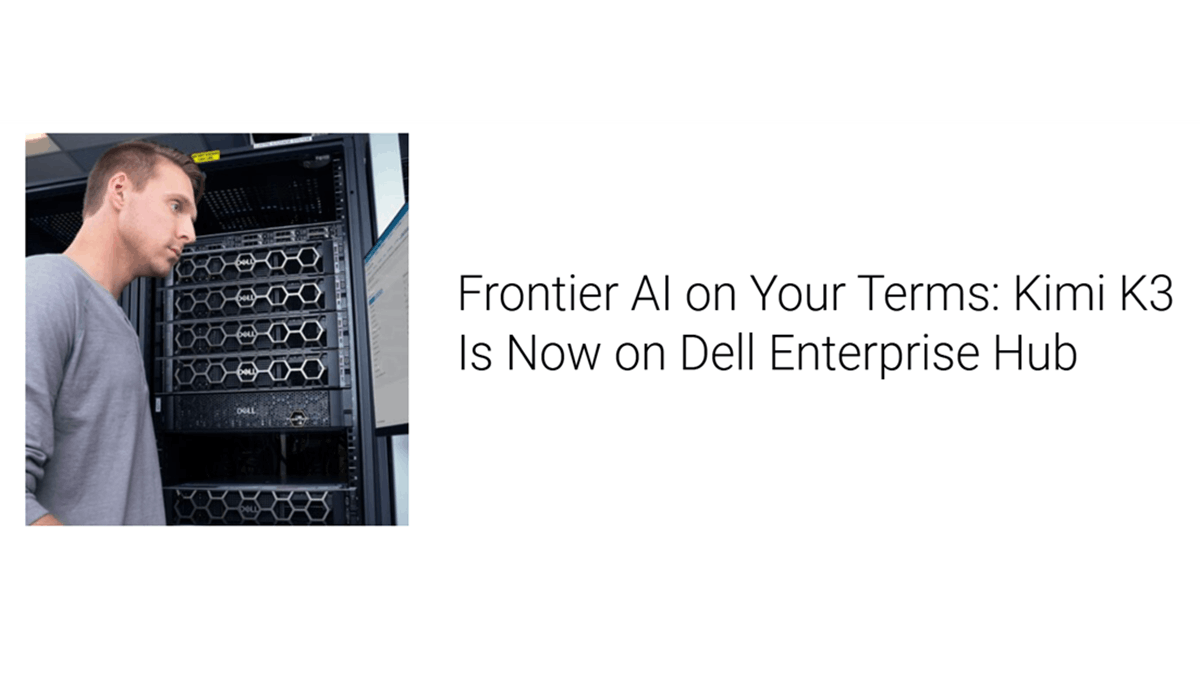
Dell Enterprise Hub Adds Kimi K3 Open AI Model for On Premises Enterprise Deployment
Analyst Perspective: Dell's decision to add Kimi K3 to Enterprise Hub extends its enterprise AI portfolio into the emerging category of frontier-class open-weight models. The announcement is not limited to model availability. It combines software, validated infrastructure, deployment tooling, and operational guidance within a single ecosystem designed for enterprise implementation.
The release also acknowledges growing customer demand for AI environments that remain under organizational control. Enterprises increasingly seek deployment models that satisfy governance requirements while maintaining flexibility in model selection, particularly for regulated workloads and proprietary data.
This addition complements Dell's existing investments across AI infrastructure, storage, servers, and management software. Instead of presenting infrastructure as a standalone offering, Dell continues building an integrated environment where enterprises can evaluate, deploy, and operate multiple AI models using consistent operational processes across private AI environments.
Kimi K3 Brings Frontier-Class Open Models to Enterprise Infrastructure
Kimi K3 introduces one of the largest open-weight foundation models currently available, containing 2.8 trillion parameters built on a Mixture-of-Experts architecture. Although the model contains trillions of parameters, only approximately 104 billion are activated during inference through a selection of 16 experts per token, reducing computational requirements compared with dense models of similar size.
The model also combines Kimi Delta Attention with Multi-head Latent Attention, enabling efficient long-context processing while maintaining reasoning quality. Native multimodal capabilities allow the same model to process text, images, and video without requiring separate vision models.
These architectural characteristics make Kimi K3 suitable for enterprise workloads involving software development, document intelligence, research repositories, inspection workflows, and AI agents operating across multiple content formats within a single deployment environment.
Dell Enterprise Hub Adds Enterprise Deployment Capabilities
Dell Enterprise Hub extends model availability with deployment services intended for enterprise production environments.
Hosted through Hugging Face, the platform provides hardware-optimized model configurations validated for Dell infrastructure. Models undergo malware scanning, unsafe serialization inspection, and signed checksum verification before publication, helping organizations verify software integrity before deployment.
Dell also incorporates Goodput-based sizing, measuring infrastructure performance against expected enterprise service levels including concurrency and context length. The Dell AI SDK further automates deployment by matching hardware resources, generating deployment configurations, allocating GPU memory, and applying platform-specific optimizations.
For Kimi K3, Dell identifies a reference configuration consisting of two PowerEdge XE9780 or XE9780L systems equipped with NVIDIA B300 GPUs, complemented by high-speed networking and Dell AI Data Platform storage infrastructure.
Sovereign AI Gains Momentum Through Open-Weight Models
The addition of Kimi K3 supports enterprise interest in sovereign AI, where organizations retain operational control of infrastructure, model deployment, and sensitive information.
Open-weight models provide greater visibility into deployment environments while allowing enterprises to customize implementations for industry-specific requirements and internal workflows. This capability is especially valuable for organizations operating under regulatory obligations or handling confidential intellectual property.
Dell also frames open-weight models as one component within a mixed AI ecosystem that includes proprietary models, allowing enterprises to select technologies according to workload requirements instead of adopting a single deployment strategy.
As AI applications continue incorporating larger context windows, multimodal processing, and autonomous agents, infrastructure ownership and deployment flexibility become increasingly valuable considerations for long-term enterprise AI planning.
Dell Continues Creating a Comprehensive Enterprise AI Platform
Dell's latest addition reinforces its ongoing investment in enterprise AI infrastructure by pairing advanced foundation models with deployment capabilities designed for production environments.
Kimi K3 complements Dell's existing portfolio of servers, storage, networking, and AI software, creating another option for organizations seeking private AI deployments with frontier-level capabilities.
Enterprises in financial services, healthcare, manufacturing, government, research, and other data-sensitive sectors are likely to benefit from greater infrastructure ownership and deployment flexibility.
Deployment Considerations
Running a model of this size requires significant computing resources, specialized networking, and careful capacity planning, placing adoption beyond the reach of smaller environments.
Organizations can address these requirements through phased implementations, workload prioritization, infrastructure validation, and performance testing before introducing production workloads.
Looking Ahead at Dell's AI Strategy
Interest in open-weight frontier models continues to increase as enterprises seek greater operational control without sacrificing model capability. Dell is well placed to benefit from this direction because its AI portfolio already spans compute, storage, networking, management software, and deployment tooling.
Continued additions to Enterprise Hub, combined with validated infrastructure and software integration, could strengthen Dell's role among organizations building long-term sovereign and hybrid AI environments while supporting a growing variety of enterprise foundation models.
Position your event or publication with perspectives that resonate across the industry. Contact us at the Collab Collective to learn how our experts can support your media coverage or speaking lineup.