 ·
3 minute read
·
3 minute read
The Brief: Microsoft and SAP announced new enterprise AI updates at SAP Sapphire 2026, with Microsoft Azure continuing as a key cloud environment for SAP customers.
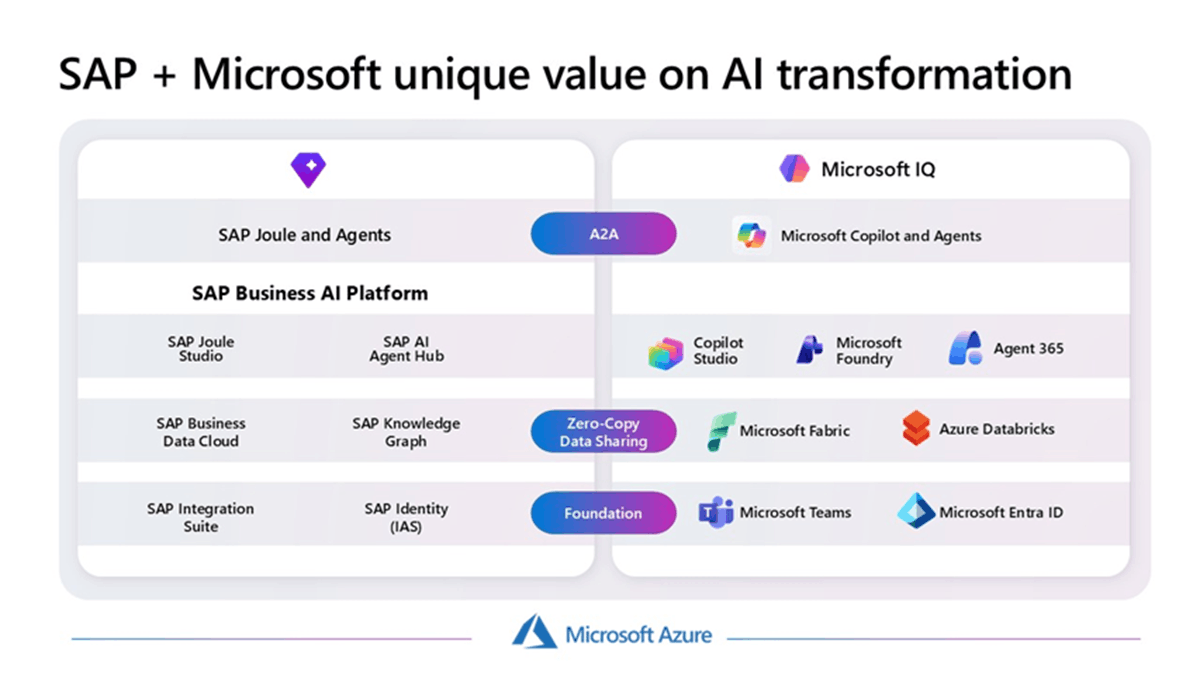
One major development is the planned agent-to-agent connection between Microsoft 365 Copilot and SAP Joule, which would allow AI tools across both ecosystems to work more closely within business workflows.
The announcement also covers stronger integration between SAP Business AI offerings and Microsoft technologies, along with new support for connecting SAP Business Data Cloud with Microsoft Fabric.
In addition, the companies shared updates on sovereign cloud offerings for highly regulated industries, wider availability of SAP Business Technology Platform on Azure, and continued investment in migration support programs. Microsoft also introduced updates to its Cloud Acceleration Factory, prebuilt AI agent use cases, and added security capabilities for SAP environments through Microsoft Sentinel.
 Source: Microsoft
Microsoft and SAP Expand Enterprise AI Partnership at SAP Sapphire 2026
Analyst Perspective: Microsoft and SAP are taking their partnership beyond cloud hosting and putting more attention on how AI can help businesses with everyday work. A major part of this announcement is the effort to connect work tools, business software, and company data so AI can move across these systems instead of working in isolation.
The planned connection between Microsoft 365 Copilot and SAP Joule shows that both companies want AI to help employees complete tasks within the tools they already use. This could make work more efficient because people would spend less time switching between platforms or manually moving information.
This also gives Azure a bigger role in the partnership. It is not just being presented as the place where SAP systems run, but also as the cloud environment supporting these new AI capabilities. For businesses, this means cloud decisions may now be influenced not only by infrastructure needs, but also by the AI tools available through that provider.
 Source: Microsoft
Enterprise AI Coordination Moves Into Business Workflows
At SAP Sapphire 2026, one of the biggest updates was the planned connection between Microsoft 365 Copilot and SAP Joule, designed to help the AI platforms work more closely within business operations.
This capability is intended to let AI tools across both platforms work in tandem on business tasks instead of operating in isolation, which could support workflows where employees begin a task in Microsoft 365 applications and continue that process within SAP business systems.
Microsoft described this as part of its broader enterprise AI framework, where artificial intelligence uses business data, workplace activity, and organizational knowledge to provide more relevant support. SAP adds business context through its enterprise applications, including ERP, finance, supply chain, and human resources platforms.
This development points to a more connected enterprise AI experience within existing software environments. For users, this means AI assistance could become part of familiar business workflows such as approvals, planning, communication, and day-to-day operational tasks.
Data Infrastructure and Sovereignty Expand the Partnership Scope
Microsoft and SAP also addressed one of the biggest issues in enterprise AI: access to reliable business data.
The companies shared plans to strengthen the connection between SAP Business Data Cloud and Microsoft Fabric, including a feature expected later in 2026 that will let businesses work with SAP data and other company data more easily, without creating multiple copies of the same information.
Microsoft also announced wider Azure availability for SAP Business Data Cloud, giving more organizations access to regional infrastructure that supports analytics and reporting needs, which can help them access information faster while keeping data management more efficient.
The companies also introduced updates for sovereign cloud services designed for industries with strict rules around where data is stored and how it is protected, such as government, finance, and healthcare.
Acceleration Programs Target Enterprise Adoption at Scale
Microsoft and SAP are adding more support for businesses that want to start using AI in real business operations.
One example is the updated Cloud Acceleration Factory, which helps companies connect Microsoft 365 Copilot with SAP Joule in SAP cloud environments like RISE with SAP and GROW with SAP. They are also offering prebuilt AI tools that can help automate common business tasks.
Microsoft also shared plans to open the RISE with SAP Acceleration Program to more customers next year. The program is designed to help businesses with the technical work involved in moving SAP systems to Azure or modernizing older setups.
The announcement included customer examples from industries such as energy, logistics, and manufacturing. Microsoft and SAP are also working with partners like EY and SNP, giving businesses more access to technical specialists who can help with deployment.
The Bigger Picture for Enterprise AI Adoption
This update builds on what both companies already do well. SAP is widely used for managing core business operations such as finance, supply chains, and human resources. Meanwhile: Microsoft brings cloud services, workplace software, data tools, and AI products.
Bringing these capabilities closer can help businesses solve a common problem: important systems often do not work smoothly with one another. When teams have to jump between disconnected platforms, decision-making slows down and automation becomes harder to manage.
This announcement is especially relevant for large organizations updating older ERP environments, improving business workflows, or working in industries with strict compliance requirements.
What Companies Will Need to Manage
Even with strong technology partnerships, implementation can still be difficult. Connecting AI tools across multiple business systems requires careful planning, especially around security, governance, employee adoption, and data management. Some organizations may also find that their business data is incomplete or spread across too many platforms, which can reduce AI effectiveness. A gradual rollout, clear internal ownership, and experienced implementation support will be important for successful adoption.
What Could Come Next
The broader enterprise software market is moving toward AI that is built into everyday business operations, and this update fits within that direction.
If Microsoft and SAP can successfully deliver these integrations, their partnership may become more valuable for organizations that want AI to support real business decisions and workflows, not just limited pilot projects or standalone experiments.
Stay current on industry shifts that impact collaboration and communication. Subscribe to the Collab Collective newsletter and lead with clarity.
%20Partnership%20Advances%20AI%20Adoption%20and%20Government%20Productivity.png)