 ·
3 minute read
·
3 minute read
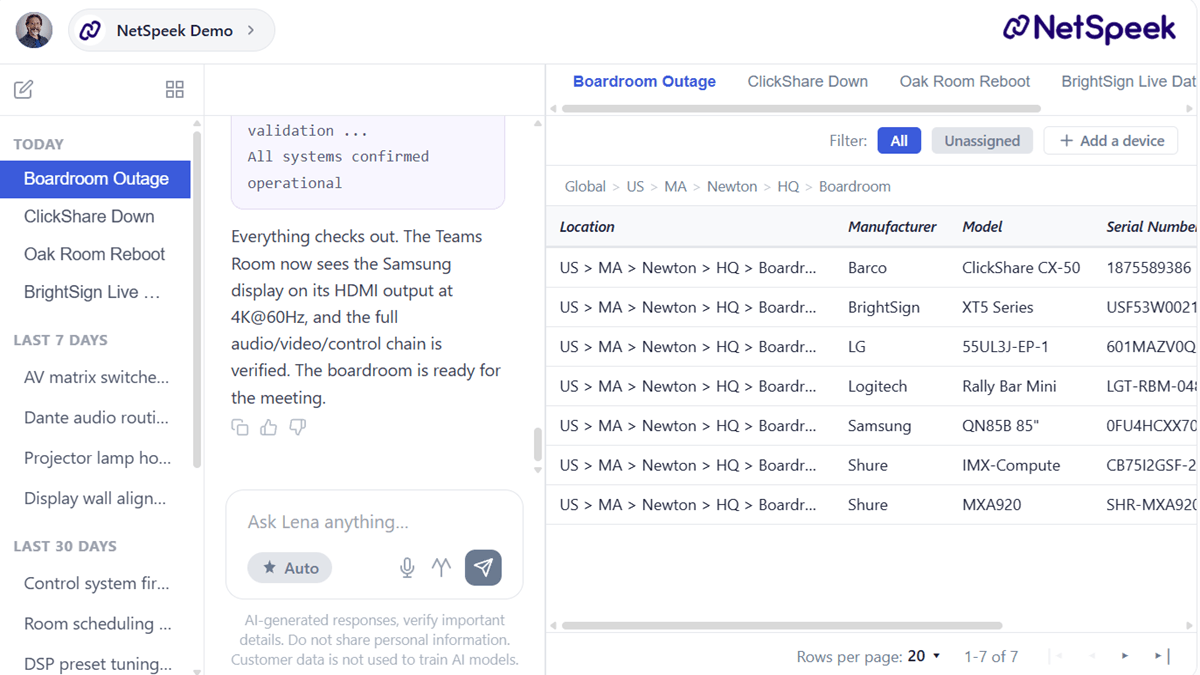
The Brief: NetSpeek announced an update to its Lena AI orchestration platform, introducing a new AI Troubleshooting capability designed to improve how organizations manage and support AV and Unified Communications environments.
The update enables Lena to detect issues, diagnose root causes, and guide or execute remediation workflows across enterprise collaboration systems. The platform is built for multi-vendor environments and leverages AI-driven reasoning and real-time context to reduce manual troubleshooting efforts.
With this release, IT, AV, and workplace technology teams can transition beyond conventional monitoring approaches to more automated operations, as Lena 1.1 works to minimize alert fatigue and improve resolution speed.
It supports enterprise deployments, managed service providers, and workplace technology teams.
NetSpeek Launches AI Troubleshooting For AV And UC Operations
Analyst Perspective: NetSpeek’s enhancement of Lena shows how operational platforms are evolving, with automation now contributing to decision-making instead of being limited to isolated task execution. The troubleshooting capability represents a structured attempt to embed intelligence within support processes.
Through system-wide analysis, the platform supports a more unified operational model. This addresses the growing need for tools that understand relationships across technologies, rather than isolating issues.
The update also reinforces the importance of adaptability in enterprise environments. As AV and UC ecosystems expand, platforms that can continuously learn and refine responses are likely to play a larger role in maintaining consistent performance and user experience.
AI Troubleshooting Introduces Context-Aware Issue Resolution
The AI Troubleshooting capability in Lena 1.1 is designed to operate across devices, rooms, and collaboration platforms, providing a unified approach to issue management.
Instead of isolating problems at the device level, the system evaluates the broader environment to identify dependencies and system behavior patterns. This enables more accurate root cause identification, particularly in complex AV and UC deployments where multiple technologies interact.
The platform applies AI-driven reasoning to analyze real-time data, allowing it to determine whether issues stem from configuration inconsistencies, connectivity disruptions, or platform-level conflicts.
Incorporating system context into its analysis enables Lena to move beyond static monitoring and support more informed decision-making. This helps organizations maintain consistency across environments while improving the reliability of collaboration technologies used in daily operations.
Automation Reduces Manual Intervention in Support Workflows
Lena’s new capability introduces guided and automated remediation workflows that aim to reduce the need for manual troubleshooting.
When issues are identified, the platform can either provide step-by-step guidance to support teams or initiate automated actions to resolve the problem, allowing organizations to balance automation with operational control in line with internal policies and requirements.
The system also enables remote resolution in many cases to limit the need for on-site intervention. This is particularly relevant for enterprises managing distributed workspaces or global deployments.
By streamlining support processes, Lena helps reduce the operational burden on IT and AV teams while improving response times, resulting in a more efficient workflow where common issues can be addressed quickly without escalating to resource-intensive support activities.
Lena Strengthens Its Role in Multi-Vendor Ecosystem Management
The update reinforces Lena’s position as an orchestration layer for multi-vendor AV and UC environments.
Modern collaboration ecosystems often include a wide range of devices and platforms, creating challenges in maintaining consistent performance and visibility. Lena addresses this complexity by providing a centralized system that integrates across these technologies.
With the addition of AI Troubleshooting, the platform extends its capabilities beyond orchestration into active system management. This allows organizations to maintain a more cohesive operational structure, even as their technology environments expand.
The ability to support enterprise IT teams, managed service providers, and workplace technology leaders highlights its adaptability across different use cases. Through unifying monitoring, analysis, and remediation, Lena contributes to a more structured and scalable approach to managing collaboration infrastructure.
Positioning AI As A Core Layer In AV And UC Operations
NetSpeek’s latest update to Lena follows a clear continuation of its existing platform strategy.
As an orchestration solution already focused on multi-vendor environments, adding AI-driven troubleshooting enhances its ability to address operational inefficiencies that arise in complex deployments. The move aligns with the growing demand for systems that not only provide visibility but also help maintain performance and uptime across distributed collaboration technologies.
Organizations managing large-scale AV and UC environments, including enterprises and managed service providers, are likely to benefit from this added layer of intelligence.
Operational Constraints to Address
Using AI-driven troubleshooting may require teams to integrate it with their existing tools and workflows, especially if support processes are already established. Connecting different systems can get complicated, particularly when trying to standardize data and responses.
Clear rules and a well-planned rollout can help keep things running smoothly.
Expected Direction for AI-Driven Operations
The introduction of AI troubleshooting suggests a continued shift toward more autonomous operational models.
As platforms like Lena evolve, the focus is likely to expand toward deeper integration with enterprise systems and enhanced learning capabilities. This trajectory supports a future where operational platforms play a more active role in maintaining system performance with minimal manual oversight.
Looking for trusted voices to shape conversations on workplace collaboration? Schedule a call with the Collab Collective today for expert commentary or speaking engagements that bring clarity and impact to your audience.