
 ·
3 minute read
·
3 minute read
The Brief: RingCentral’s Agentic AI Trends 2026 report examines how organizations in Financial Services, Technology, Healthcare, and Retail are progressing with AI.
The research covers 2,000 respondents, including 1,716 with AI strategy. Across the sample, 86% have a long-term AI strategy and 83% have launched at least one AI initiative, while 53% have launched multiple initiatives.
The findings compare AI objectives, deployment activity, time to first deployment, return on investment, digital-worker adoption, satisfaction, and project course correction. Technology and Financial Services report the highest deployment rates, while Healthcare and Retail show different adoption patterns shaped by their operating environments.
The report gives leaders industry context for AI investment and deployment decisions.
Learn full details about RingCentral’s AI maturity trends at ringcentral.com.
 Source: RingCentral
RingCentral’s Agentic AI Trends 2026 Report Reveals How Industries Advance AI Maturity
Analyst Perspective: RingCentral’s report makes industry context essential to understanding AI progress. The same deployment metric can represent different levels of readiness when the use cases, regulatory requirements, and data environments differ. This is clear in the contrast between Retail’s first deployments and Healthcare’s timelines.
The findings also suggest that maturity should include the ability to manage an AI portfolio. Satisfaction reaches 92% across respondents with deployed AI, yet 42% have paused or canceled an initiative. These figures are not inherently contradictory. Organizations can be satisfied with their AI efforts while removing individual projects that no longer justify continued investment. Technology’s higher rate of course correction fits this pattern and is consistent with its higher deployment activity.
For RingCentral, presenting these measures in one research view makes the report especially useful for leaders planning the next stage of adoption. It connects strategic intent with deployment behavior and clear measurable outcomes without treating one metric as sufficient.
 Source: RingCentral
Industry Priorities Shape What AI Is Expected to Deliver
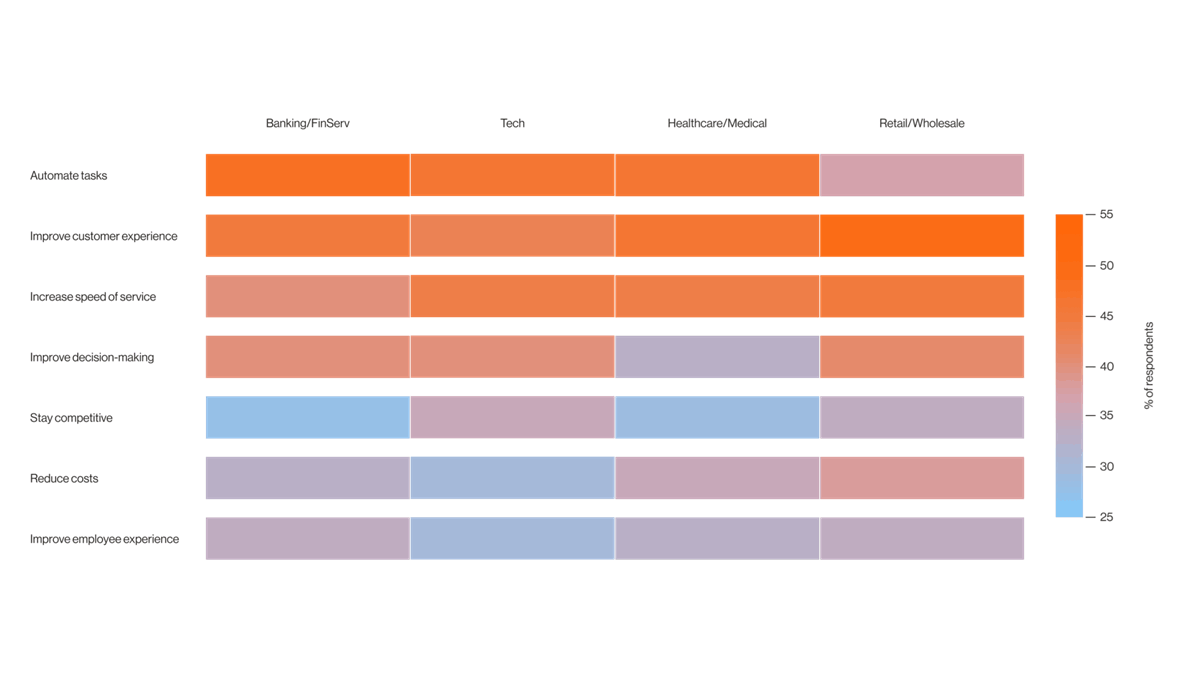
Organizations are pursuing AI for several business objectives, but those priorities vary across industries. Among the 1,716 respondents with some degree of long-term AI strategy, the leading goals include customer experience, task automation, and AI-assisted decision-making.
Financial Services places the strongest emphasis on task automation, which fits workflows involving frequent transaction processing. Healthcare gives less weight to AI-assisted decision-making, where clinical expertise and human judgment remain important considerations. Retail gives greater attention to customer experience and cost reduction, two areas with direct implications for customer loyalty and margins.
These differences matter when considering AI maturity. A company pursuing automation across transaction-heavy workflows may require different capabilities and safeguards from a retailer pursuing customer-facing improvements. Industry objectives therefore provide useful context for understanding why organizations select different AI initiatives and allocate resources differently.
Deployment Speed Does Not Tell the Whole Story
AI deployment rates vary considerably across the four industries. Financial Services and Technology each report that 87% of respondents have launched at least one AI initiative. Healthcare follows at 77%, while Retail records 71%.
The timing of those deployments also differs. Overall, 69% of organizations deployed their first AI initiative within one year. Financial Services had 27% of respondents taking longer than a year, while Healthcare had 39% either taking more than a year or still rolling out their first initiative.
Retail moved more quickly in some cases, with 37% reporting a first deployment in less than six months. The difference can be linked to the nature of initial use cases and operating requirements. Financial Services and Healthcare must contend with regulatory demands and sensitive data, which can require additional preparation before deployment.
The findings make deployment speed an incomplete measure of organizational readiness.
ROI and Digital Workers Add Another Measure of Progress
Return on investment provides another way to examine how AI initiatives are progressing after deployment. Among organizations that had deployed AI, 77% reported seeing ROI within the first year. Financial Services and Technology recorded the fastest paybacks, despite differences in their deployment timelines.
Digital-worker adoption provides an additional indication of how deeply AI is being used. In both Financial Services and Technology, 43% of respondents are either deploying digital workers at scale or have embedded them across operations. Healthcare records 28%, while Retail reaches 32%.
The figures distinguish initial experimentation from more extensive operational use. They also show why deployment counts alone offer limited insight into maturity. An organization can launch an AI initiative quickly without having integrated AI deeply into its operations, while another may take longer because its use cases require more extensive governance or data preparation.
AI Maturity Depends on How Organizations Manage the Full Journey
The findings give business leaders a way to consider AI maturity through several measures instead of relying on deployment speed alone. Objectives establish what AI is expected to accomplish, deployment shows how initiatives move into use, ROI provides evidence of business value, and digital-worker adoption offers insight into operational integration.
There are also challenges that may arise with organizations working with regulated processes or sensitive information. They may face longer implementation timelines, while companies running many initiatives must determine which projects deserve continued investment. But clear use-case selection, governance, measurable outcomes, and regular review can help address these issues.
Where the Next Stage May Emerge
The data suggests that Technology and Financial Services have developed greater experience with AI initiatives, while Healthcare and Retail continue along paths shaped by their own requirements. For customers considering further adoption, the most useful model may be one that accounts for risk, business objectives, deployment complexity, and measurable value.
The ability to stop or modify weaker initiatives should remain an important consideration. AI maturity is not simply about launching more projects: it also involves learning from deployments and making informed investment decisions as results become clearer.
Looking for trusted voices to shape conversations on workplace collaboration? Schedule a call with the Collab Collective today for expert commentary or speaking engagements that bring clarity and impact to your audience.

%20January%202026%20Release.png)