 ·
3 minute read
·
3 minute read
The Brief: Salesforce has introduced Headless 360, a new platform capability that makes its entire ecosystem accessible through APIs, MCP tools, and CLI commands, eliminating the need for traditional browser-based interaction.
The update enables AI agents to directly access data, workflows, and business logic across Salesforce without relying on user interfaces.
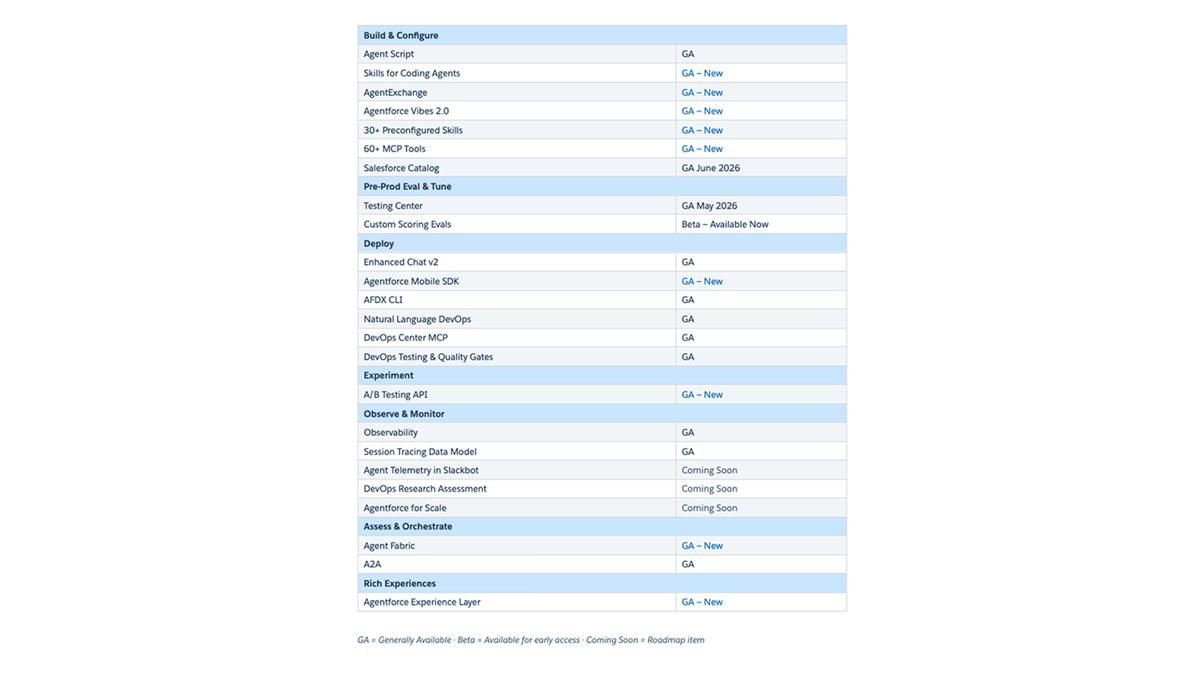
Moreover, Headless 360 includes more than 60 MCP tools and over 30 preconfigured coding skills, along with a new experience layer designed to render interactive components across multiple channels such as Slack, mobile, and messaging platforms.
It also introduces lifecycle tools for testing, monitoring, and optimizing agent behavior in production environments.
Learn full details of the announcement about Salesforce Headless 360 at salesforce.com.
 Source: Salesforce
Salesforce Headless 360 Introduces API Native Platform for AI Workflows
Analyst Perspective: This release highlights Salesforce’s effort to consolidate its ecosystem into a programmable layer that supports both human users and AI agents. By standardizing access through APIs, MCP tools, and command-line interfaces, the company is simplifying how developers and systems interact with its services.
Headless 360 also reflects a broader move toward integrating AI capabilities directly into operational workflows. The ability for agents to access real-time data and established business logic suggests a more cohesive execution model, where decision-making and action can occur within the same environment.
Another notable aspect is the emphasis on interoperability. By supporting external tools and development environments, Salesforce is positioning its platform as a flexible foundation that extends beyond its native applications, enabling broader adoption across diverse enterprise technology stacks.
 Source: Salesforce
Expanded Access Through APIs, MCP Tools, and CLI Commands
Salesforce Headless 360 introduces a unified access model where all platform capabilities are available through APIs, MCP tools, and command-line interfaces.
This design allows both developers and AI agents to interact directly with Salesforce data, workflows, and business logic without navigating a graphical interface. The approach supports integration with widely used coding environments, allowing development teams to operate within familiar tools while maintaining real-time connectivity to enterprise systems.
The release includes more than 60 MCP tools and over 30 preconfigured coding skills, providing immediate functionality for common development and automation tasks. These capabilities extend to continuous integration and deployment pipelines, where natural-language inputs can trigger deployments.
This reduces reliance on manual configuration and enables more consistent execution across environments, improving development efficiency while maintaining alignment with organizational requirements.
Experience Layer Enables Multi-Channel Interaction
A key component of Headless 360 is the introduction of the Agentforce Experience Layer, which separates backend functionality from how interactions are presented to users. This layer enables agents to deliver structured, interactive components such as approval requests, workflow steps, and data visualizations across various platforms.
These components can be rendered natively in communication tools including Slack, as well as in mobile applications and other supported environments. The design supports consistent interaction patterns regardless of where the user engages with the system.
By embedding workflows directly into communication channels, Salesforce enables users to complete tasks without switching contexts, enhancing operational continuity and allowing both human users and AI agents to collaborate within the same environments. This improves overall efficiency and responsiveness.
Tools for Managing Agent Behavior Across Lifecycle
Salesforce has introduced a set of tools designed to manage and evaluate AI agent performance throughout its lifecycle.
Before deployment, the Testing Center identifies potential issues such as logic inconsistencies and policy violations. Custom scoring evaluations allow organizations to define criteria for successful outcomes, ensuring that agent decisions align with business requirements.
After deployment, observability and session tracing provide detailed insights into agent actions, including the reasoning behind decisions. This level of visibility supports faster identification of performance issues and enables ongoing optimization.
Additionally, A/B testing capabilities allow multiple agent configurations to be evaluated in real-world conditions, supporting data-driven improvements. These tools collectively provide a structured framework for maintaining reliability and consistency as organizations scale their use of AI-driven automation.
Positioning Salesforce for Agent-Driven Enterprise Operations
With Headless 360, Salesforce builds on its existing products like Customer 360, Data 360, Slack, and Agentforce.
This update helps the company support businesses that rely more on automation and AI to get work done. Instead of depending on manual input, users and systems can now access data and workflows directly, making processes quicker and more efficient.
Addressing Enterprise Needs
Many organizations experience slowdowns because their systems don’t integrate well and tasks still require manual work.
Headless 360 reduces these delays by enabling agents to operate across unified data and workflows, helping complex operations move faster and deliver consistent results.
Managing Operational And Technical Complexity
Moving to a fully programmable model may require organizations to rethink governance, integration strategies, and workforce readiness.
To keep things running smoothly, it helps to put clear frameworks and monitoring tools in place so agents stay within policies and meet compliance standards.
How Enterprise Automation May Evolve
Salesforce is set to further develop its agent-related offerings, with continued work on automation and smoother integrations across tools and platforms.
Meanwhile, as companies rely more on AI to complete tasks, solutions that unify data, workflows, and governance will become essential in guiding how enterprise systems operate.
Technology providers rely on timely insights to stay competitive. Reach out to us at the Collab Collective to discuss how our research and advisory services can support your growth plans.