 ·
3 minute read
The Brief: Talkdesk has launched Talkdesk Voyager, a customer journey orchestration product that enables enterprises to automate engagement and coordinate activities across extended customer lifecycles. The solution runs natively on the Talkdesk Customer Experience Automation (CXA) platform, combining multi-agent orchestration, workflow automation, persistent context, and enterprise integrations.
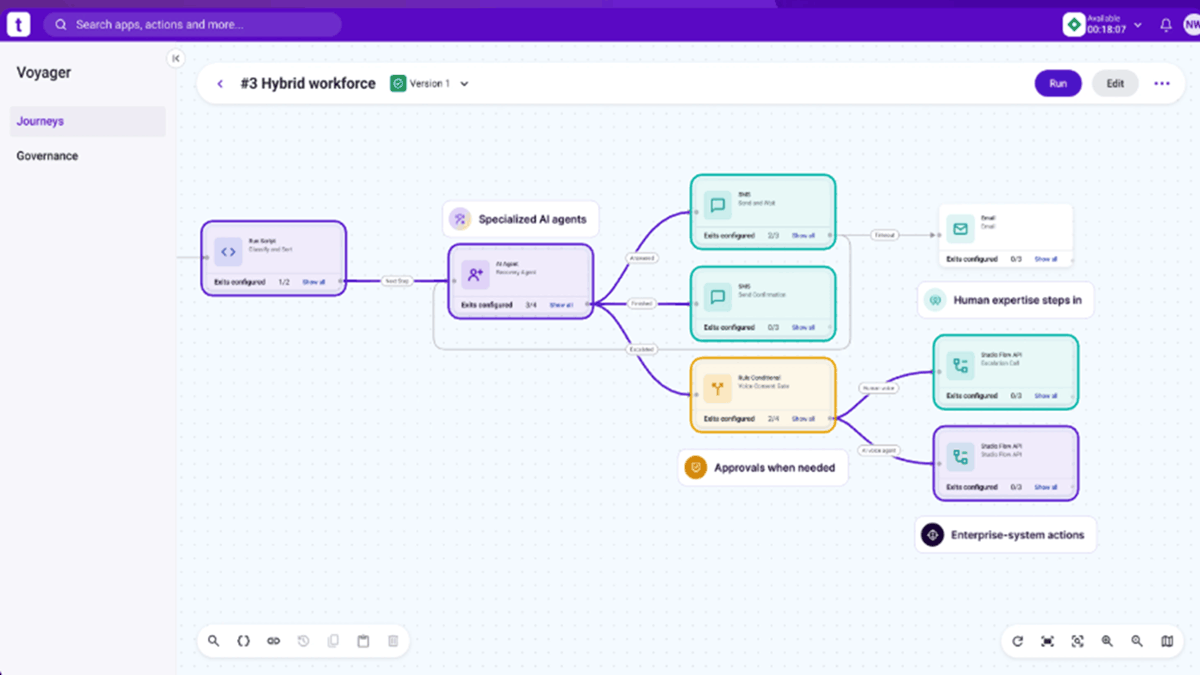
Voyager uses customer information and business events to determine when action is needed and initiate personalized customer journeys. From there, it coordinates specialized AI agents, employees, and enterprise systems to advance each journey toward a defined business goal. Its initial industry blueprints cater to healthcare, retail, and financial services, with use cases that range from preventive care and appointment scheduling to purchasing, product replenishment, loan applications, and customer retention.
Businesses can deploy existing configurations or adapt them to their operational requirements, with governance controls and monitoring capabilities supporting enterprise oversight.
Find full details of the announcement about Talkdesk Voyager at talkdesk.com.
 Source: Talkdesk
Talkdesk Announces Voyager for AI-Powered Customer Journey Automation
Analyst Perspective: Enterprise AI is developing toward systems that can manage tasks across different applications and business departments. Talkdesk Voyager supports this development by using multiple AI agents to manage customer journeys that involve several steps and require ongoing attention. Each AI agent handles specific tasks while contributing to a shared customer goal.
Voyager also connects customer experience platforms with existing business applications. It can use customer information stored in CRM, EHR, and ERP systems to determine what actions should follow. So businesses can continue using their existing applications without replacing them, which is particularly important when automated workflows involve sensitive information, such as financial records, medical data, and customer transactions.
By integrating Voyager into its existing Customer Experience Automation (CXA) platform, Talkdesk gives businesses more ways to automate complex processes while continuing to use the tools and systems they already have.
 Source: Talkdesk
Multi-Agent Coordination Connects Individual Tasks
Talkdesk Voyager connects specialized AI agents, human employees, and enterprise systems so they can work on different tasks within the same customer journey. Each participant handles specific responsibilities, but all activities contribute to a shared business objective. This allows enterprises to coordinate processes across multiple departments and applications without creating separate automation projects for every task.
Consider a loan application, for example. The process may require document collection, customer communication, internal reviews, and approval from an authorized employee. Voyager coordinates each step and determines what needs to happen next as new information becomes available or circumstances change.
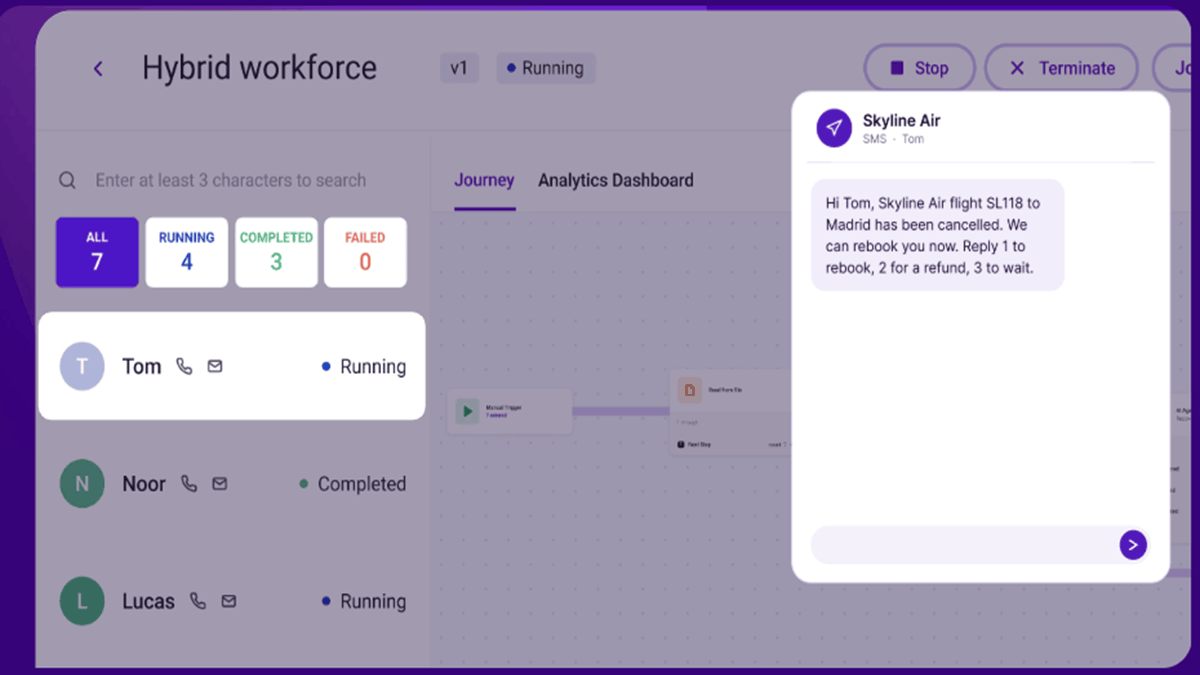
Businesses can also establish rules at the organizational level to determine when a journey begins. From there, each customer receives an individual journey with its own context, progress, and completion conditions, giving enterprises a consistent way to manage different customer requirements.
Enterprise Integrations Connect Customer Data with Action
CRM, EHR, and ERP applications hold valuable information that helps businesses understand customer needs and determine what should happen next. Voyager draws on these existing enterprise integrations to access relevant data and coordinate activities across different systems. It also connects natively with the CXA platform, bringing together AI agents, Studio, Automation Flows, and context stores within the same environment.
With this integration, businesses can introduce extended automation without replacing their existing technology investments. Their enterprise applications remain the systems of record, while Voyager coordinates the tasks needed to move each customer journey forward.
The benefits extend to organizations with complex, cross-departmental operations. Since customer information and business events can guide subsequent tasks, employees no longer need to manually coordinate every step of a process.
Time, Context, and Intelligence Sustain Journey Execution
Voyager's architecture brings together three capabilities that help businesses manage customer journeys over extended periods: time, context, and intelligence.
Time allows the platform to track each journey's status, record completed activities, identify outstanding requirements, and determine when the process should end. Meanwhile, context connects information from previous interactions, enterprise applications, and communication channels, giving AI agents the details they need to respond appropriately. Intelligence then enables these agents to determine and carry out the next steps as customer circumstances change.
To maintain this continuity, Voyager uses long-term memory to retain useful customer preferences and interaction history, subject to privacy and access controls. So businesses can provide relevant responses without asking customers to repeat details they have already shared.
The platform also coordinates responsibilities between AI agents and human employees. AI agents manage tasks across enterprise applications and communication channels, while employees address activities that require specialized knowledge or authorization. To keep these activities within established boundaries, Voyager provides monitoring tools, safeguards, and escalation procedures for continued business oversight.
Connecting Enterprise AI with Measurable Business Objectives
Talkdesk Voyager builds on the CXA platform by introducing capabilities for enterprise processes that span multiple systems and require consistent customer context. It draws on existing technologies within the Talkdesk portfolio, such as AI agents, workflow automation, and enterprise integrations.
Bringing these capabilities into extended customer journeys represents a natural progression for Talkdesk as it continues to develop its customer experience automation offerings.
Enterprise Readiness and Operational Requirements
Businesses with lengthy customer lifecycles have several opportunities to use Voyager, particularly in healthcare, financial services, and retail. These industries often require employees to coordinate activities across different applications, departments, and customer interactions.
Voyager can simplify this process by managing related tasks, although successful deployment will require reliable system integrations, accurate information, and appropriate access permissions.
Enterprises must also address data protection and set clear boundaries for automated decisions, including when employees should step in. Testing workflows individually before a wider rollout will allow businesses to identify operational issues, adjust their business rules, and confirm that each automated process meets its intended requirements.
What Comes Next for Agentic CXA
The long-term value of Talkdesk Voyager will depend on how consistently it can manage customer journeys across different business environments. Although its pre-built configurations give enterprises a starting point, organizations will still need to customize workflows and establish measurable performance indicators to evaluate their effectiveness.
As agentic AI continues to develop, coordinated execution could become an increasingly important capability for customer experience platforms, especially as businesses look to connect service automation with customer acquisition, retention, and operational efficiency.
Gain valuable perspectives on AI, collaboration tools, and workplace innovation. Subscribe to the Collab Collective newsletter for expert insights delivered directly to you.