
 ·
3 minute read
·
3 minute read
The Brief: Zoom has introduced a new set of AI capabilities centered on Zoom AI Companion, which expands its role into a system built to bridge conversations and execution.
The update includes the expansion of AI Companion 3.0, adding broader contextual awareness across Zoom Workplace and third-party applications, as well as new agent and workflow builders that enable task automation.
The company also unveiled AI-first canvases, including AI Docs, AI Sheets, and AI Slides. These canvases help teams convert discussions into structured outputs, such as documents, spreadsheets, and presentations. They aim to reduce manual effort and improve workflow continuity.
Zoom also announced AI Services, a suite of APIs that support transcription, translation, and reasoning.
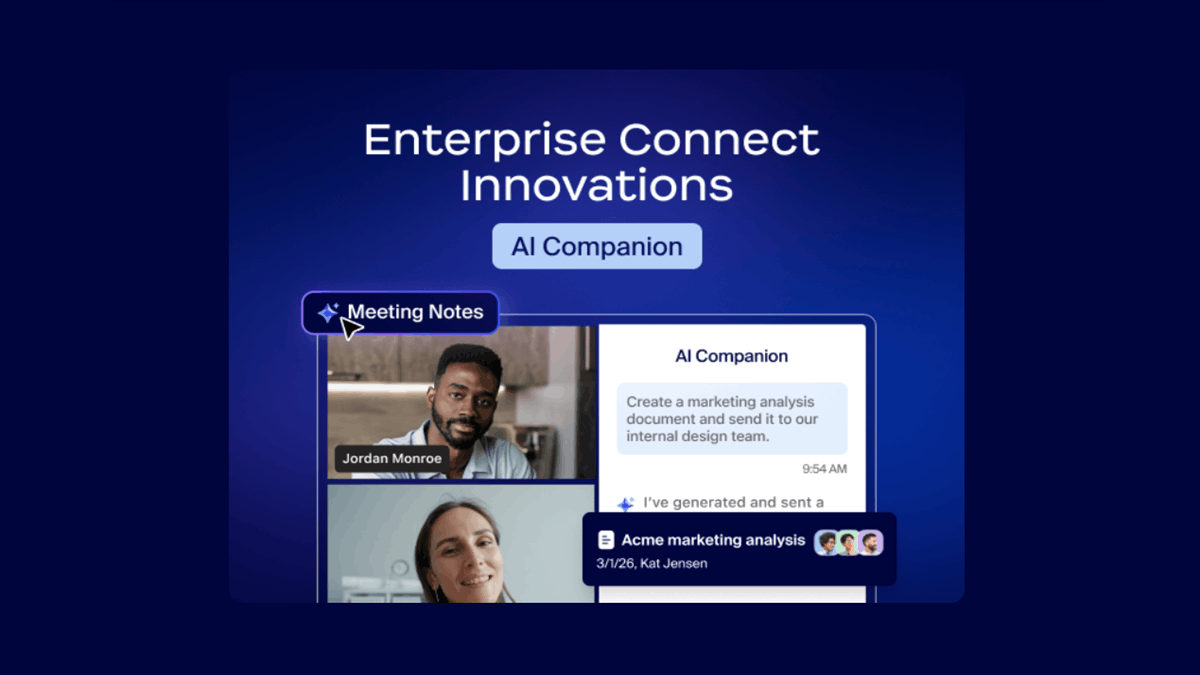
Zoom Announces New AI Innovations with AI Companion, AI Docs, AI Sheets, and AI Slides
Analyst Perspective: The update shows Zoom’s intent to improve the way work progresses after conversations take place. Meetings and chats are not treated as endpoints anymore because the platform now extends into task completion through integrated AI workflows. This responds to the rising need for tools that reduce operational friction.
The custom agent builder adds flexibility for different teams, letting organizations tailor automation to sales, marketing, IT, and other use cases. That makes the feature more useful for teams that have certain needs and varied workflows.
Zoom’s broader ecosystem strategy becomes clearer with the inclusion of APIs and external integrations. Developers can build on its AI capabilities, which allows the company to serve both as a productivity platform and as a foundation for AI-driven applications.
AI Companion Advances Workflow Automation and Context Awareness
Zoom AI Companion 3.0 has now expanded contextual capabilities to gather insights across Zoom Workplace tools like meetings, chat, and phone, as well as external platforms. This gives users access to relevant data without the need to switch between systems manually.
The update also includes intelligent agent and workflow builders that provide templates for functions such as sales, marketing, and IT. These tools can automate routine processes like CRM updates and report generation.
Additionally, AI Companion helps users follow through on meeting outcomes by supporting task completion through predefined workflows. The system integrates with third-party applications including ServiceNow, Box, and Google Drive, which ensures that information flows seamlessly across environments while maintaining a unified experience.
AI First Canvases Transform Conversations Into Structured Outputs
As part of its AI-first productivity strategy, Zoom also introduced AI Docs, AI Sheets, and AI Slides, which help users convert discussions and unstructured data into usable outputs.
- AI Docs enables teams to organize meeting insights into structured documents while supporting real-time collaboration.
- AI Sheets focuses on transforming raw data into actionable insights by automating data entry, generating formulas, and enabling natural language queries.
- AI Slides allows users to create presentations directly from meeting content, with built-in editing and formatting capabilities.
These tools are made to reduce the time between idea generation and final output. They also provide a centralized workspace where teams can collaborate and refine deliverables without relying on different external applications.
Zoom AI Services and Platform Expansion Support Enterprise Use Cases
Another thing that Zoom unveiled is the AI Services, which is a suite of enterprise-grade APIs that bring its AI capabilities into external applications. These APIs support transcription, translation, summarization, and reasoning, and they enable developers to integrate Zoom’s AI into their own applications.
The Scribe API, focused on transcription accuracy, is the first offering in this suite. The platform supports both cloud-based and planned on-premises deployments to suit different enterprise requirements.
Additionally, AI Companion is expanding into more areas, including Workvivo and a dedicated interface within Zoom Workplace, with features like personalization and memory to allow the system to adapt to user preferences over time.
With these updates, Zoom is trying to provide a more consistent and scalable AI experience across different environments.
Zoom Establishes AI as a Foundational Layer for Work Execution
Zoom’s latest innovations tackle the challenges of modern work environments, where disconnected tools can slow progress and weaken context. With AI Companion linking conversations directly to execution, the platform reduces manual follow-ups, fragmented workflows, and other inefficiencies.
AI Docs, Sheets, and Slides enhance this capability further by allowing faster content creation within a unified workspace. These features are especially valuable for distributed teams and organizations handling high volumes of collaborative tasks.
One thing to note is that adoption may depend on how easily teams can integrate these tools into existing processes and how effectively the system maintains accuracy across different data sources. Effective onboarding and governance will play a key role in maintaining consistency.
Looking ahead, Zoom is well placed to strengthen its role in enterprise productivity as demand increases for platforms that unify communication, automation, and execution.
Gain valuable perspectives on AI, collaboration tools, and workplace innovation. Subscribe to the Collab Collective newsletter for expert insights delivered directly to you.